“U” is for Upgrades (Pre-trip planning)

Upgrades are a wonderful thing, they usually mean an opportunity to have a little more comfort.   They come at a cost too but here’s the thing, there are a lot of ways to go about getting an upgrade, which can be quite frugal.   For example, we booked our cruise as a guaranteed cabin.  This is generally a less expensive way of reserving a room but it comes with some restrictions.  It means we don’t get to choose our room location but there is  “guarantee” of a certain level.  I don’t generally like doing this because I am really fussy about where our room is positioned on the ship.  We don’t want to be under pools, fitness areas, smoking lounges, teen centers, laundry room or near elevators.  We want the middle of the ship because it is more stable when we hit rough seas.

The cruise we are about to sail on,  had been nearly sold out when we finally decided to change our plans from a September sailing to a March sailing.  As payment dates neared, I was watching the site like a hawk, knowing passengers often cancel around that time.  We began to notice that actual cabins were becoming available so we began checking regularly, hoping for a room in our desired location.

As soon as a room was available, I was on the phone to our travel agent, who then locked it down for us. There was no additional cost and we now had a specific room.  Sometimes patience is all which is needed.  Now we are in a wonderful location.  It is on the port side of the ship which will allow us to enjoy sunsets and be able to see every port we sail into and all the land masses as we are sailing by.  I couldn’t have picked a better location, even if I had had first choice!

Then came another opportunity.  Last week we were offered to upgrade our perfect room to a mini suite or better.  We momentarily contemplated it knowing the perks which come with it (such as more space and possibly even a private butler) but we know better than to take these offers, because there is no guarantee about where you will be placed on the ship, so while the cabin might be bigger, with many more amenities,  the view, the noise levels etc., might be less than comfortable.  We will be sticking with our current cabin.  As they say in card games, you have to know when to hold em’. so no more upgrades on the cruise side of things!

As I have mentioned before, we are pretty frugal, some would even call us tight.  We spent 30+ years working our butts off to be able to travel like we do now.   The airlines have been slowly changing the seating in planes, a little less cushioning, a little less legroom, a narrower seat.  It has become almost dangerous to fly economy anymore, We began upgrading to Premium Economy, its now what regular seats use to be.  With Alan’s height, this gives him just a little more leg room and has been worth the extra comfort.  Business Class is another level altogether.  This is not normally the way we fly, as we find it very expensive for the return on investment.  We can generally get through about 8 hours before starting to get really uncomfortable and so far, that has been our longest air time in one stretch.

We upgraded to Business Class when we flew back to England recently…there had been a “too good to turn down offer” and we paid the extra money to do it.  Sometimes the deals to Europe aren’t very much extra to upgrade, when a flight is full.  Perhaps it was a mistake, because now we have realized what we have been missing and the  comfort which this class of travel offers. The problem with taking some of these upgrades is that once you experience them, you don’t want to go back.

With the upgrade we could load 70 pounds into our suitcases instead of 50 (which we never recommend because ultimately it is you that has to pull that case).  With the Business Class upgrade we were greeted with champagne and served food on real plates. We could lay flat and turn our seat into a bed.  During our layovers, we also had access to showers and lounges, hot meals, drinks and alcohol all day. We could  use the lounge to charge our phones and enjoy free wi fi.  We could sit in oversized cushy chairs as we waited between flights. The lounges were mostly quiet, so we could rest. We were now officially spoiled.

We began to reconsider our trip to ASIA, which involves 29 continuous hours of travel.  Even Premium Economy was going to be uncomfortable.  We decided to figure out how to make the upgrade to Business Class work for ourselves but we still didn’t want to spend much money.   We are not (yet) masters of using mileage points for upgrades etc., but our particular card lets us purchase tickets with our points, 1 mile= $1.  When we realized that we still had mileage from our last cruise and we had just used the same card to pay for our current cruise, we also realized we could make this work to our advantage.

After our 2023 trip, we had learned to always book a changeable ticket, so when we asked to upgrade, there was no problem.   We had actually booked our Premium Economy seats nearly a year before the trip, but the best international fares generally come out about six weeks before a travel date, so again Alan had been monitoring the fares, always hoping to restructure to save a little more money.  The day after we returned from England, the best fare finally hit.  It was a couple thousand dollars less than just the day before!   The Business Class fare was now within our reach.  This is when we knew to make use of our points.

For just a few hundred dollars more, we are now traveling to Singapore, in style! The bench like seats are about twice as wide as normal Premium Economy seats, they convert to a full lay flat bed so we will be able to sleep on the plane.  The “room” on All Nippon Air (ANA)  allows us to cocoon ourselves completely away from others and is considered one of the most unique features of the airline.

Even as early as today, we are still watching the fares, they have since risen to astonishing rates and have almost doubled from where they were when we booked!   Nothing feels better than feeling like we got a super bargain!  Our best advice is to consider your “why” when deciding if an upgrade is worth it, then make it work for you.    When we arrive at 1am after a 29 hour travel day we hope to be touring just 8 hours later.  With the upgrade, we will arrive refreshed and ready to enjoy our adventure, from the first hour we set foot in Singapore.

Once again we are counting our blessings.  We are humble enough to recognize this is a luxury.  We are wise enough to realize that some opportunities only knock once.  We are so grateful to have the opportunity to travel at all. Our Golden Years are about grabbing life by the horns!
“T” is For TSA Approved Travel Snacks-Travel Tips & Tricks

TSA APPROVED TRAVEL SNACKS

  • Apples *be warned, they make some people gassy.  If you slice these before travel, make sure to treat with Fruit Fresh or lemon juice to prevent browning.
  • Baked oatmeal
  • Bananas
  • Bell Pepper strips
  • Blackberries-whole
  • Blueberries-whole- *Blueberries can be frozen and used as an icepack that TSA won’t confiscate
  • Breakfast bars
  • Breakfast burritos (scrambled egg with diced veggies
  • Breakfast cookies
  • Breakfast sandwich
  • Carrots
  • Celery
  • Cheese sticks/slices
  • Cherries
  • Coconut
  • Cooked ground beef or turkey
  • Cookies
  • Crackers
  • Cucumber
  • Dehydrated/dry fruit
  • Deli meat *perishable item
  • Dry cereal
  • Edamame
  • Energy balls
  • Fruit roll ups
  • Granola/Granola bars
  • Grapes-whole or cut *grapes can be frozen and used as an ice pack which TSA won’t confiscate.
  • Grilled beef, chicken, pork, turkey
  • Hard Boiled Eggs*perishable so shouldn’t be kept at room temperature for more than a couple of hours.
  • Jerky
  • Kiwi-whole or cut
  • Melon-cut, cubed or balls
  • Muffins
  • Nut butters
  • Nuts *unsalted are best
  • Oatmeal (dry packets/cups)-just add hot water
  • Oranges-whole or peeled
  • Pasta (cooked)
  • Peaches (whole or cut up) *treat cut fruit with fruit fresh or lemon juice to prevent browning
  • Pears (whole or cut up) *treat cut fruit with fruit fresh or lemon juice to prevent browning
  • Pineapple (cut up)
  • Plums (whole or cut up)
  • Popcorn
  • Potato wedges
  • Pretzels
  • Quinoa (cooked)
  • Raisins
  • Raspberries-whole
  • Rice (cooked)
  • Rice cakes
  • Roasted chickpeas, pumpkin seeds etc
  • Roasted potatoes and/or veggies
  • Salad
  • Salad dressing *must be put in a container 1 oz or less and passed through with your liquids
  • Sandwich/wraps *Some sandwiches can be frozen the night before to help with transport. Lunch meats are perishable so make sure to keep the sandwich cool when traveling.
  • Smashed potatoes
  • Sugar snap peas
  • Strawberries-whole or sliced (no juice)
  • Trailmix
  • Veggies-mixed
  • Watermelon-whole, cut, or balls
  • Whole grain, vegetable and bean salad

Foods to Avoid-These foods can leave you feeling bloated and/or dehydrated.

  • Salty snacks such as potato chips
  • Very sugary snacks
  • Caffeine
  • Heavy foods such as pizza and hamburgers
  • Smelly foods which could disturb other passengers


Tips for Food and Drinks

Fill an empty water bottle, or purchase a bottle of water once you are on the other side of security.

Always pack some food when you are traveling.  You do not know when/if you might get stranded on the tarmac, or in the airport.    If the plane pulls away from the gate, flight attendants are not allowed to dispense food or drink until the plane is in the air.

Keep hot food hot by packing in an insulated thermos.

Consider freezing some foods (such as sandwiches/muffins) the night before you travel.  Freezing them helps to protect them longer.  By the time you are ready to eat, they will defrost.

Carry condiments (ketchup, mustard, mayo etc) in individual sized serving packets.  These must be passed through security with your other liquids.

Almond butter, peanut butter, hummus etc are considered “creams” and must be passed through security with your other liquids. *However, if these are spread on a sandwich, they are acceptable to pass through in a food bag.

Avoid drinking coffee/tea on a plane.  The water used to prepare these is stored in a holding tank, which is never cleaned.  Choose canned sodas, bottled water and boxed/bottled juices instead.

Fruits, vegetables and meats are generally allowed on a flight, however many international flights will not allow you to remove these items from the plane once you land (due to agricultural laws).   Food should be consumed while in flight and/or disposed of carefully.

Foods such as sandwiches and cut fruits/vegetables must be wrapped or in a container.  Whole foods such as apples and bananas do not need to be packed in containers.

Pack a  plastic spoon, fork, knife, napkin and wet wipe (for each person) with your food kit.  *I also pack a travel straw, but this is optional.

“A” is For Art at the Airport-ABC Air Travel

Airports are busy places.  Often we rush around and miss much of what is offered there.

Have you ever been stuck at an airport and/or had a long layover and wondered how to pass time?   Why not design a self paced art tour while you are waiting?

This was how we created our next ABC Adventure.   Our mission would be to see as many art installations as we could, while traveling through airports. We wondered if we could complete an entire alphabet. The next time we find ourselves with some time, it will be a great excuse to walk around and get some exercise.  On this day we passed 2 hours walking from terminal to terminal at Chicago O’Hare Airport.

In our quest to complete the alphabet, we have found paintings, sculptures, fiber art and so much more.  Airport art rivals that of any gallery.  The long walls, high ceilings and open spaces lend themselves to bigger installations of art.

The next time you are stuck in an airport, take a look around.  Can you complete a full ABC adventure with art as your theme?

As we try to complete the alphabet tour, we will continue to add photos as we travel and the airport locations which we find them, so be sure to check back often.

A is For

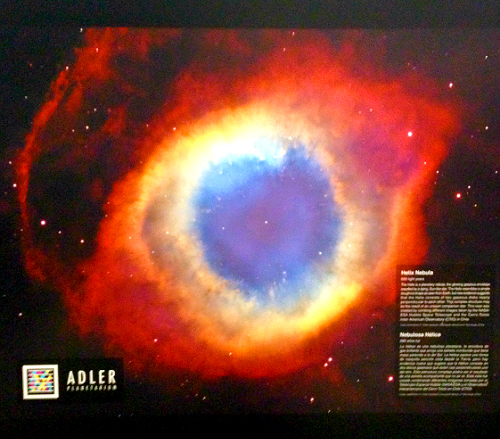
Adler Planetarium Exhibit (Chicago O’hare Airport)

The Adler Planetarium has an exhibit in the Pedestrian Walkway on the way to the CTA O’Hare Blue Line Station. The Exhibit features many posters such as the one above offering views of beautiful constellations in the night skies.

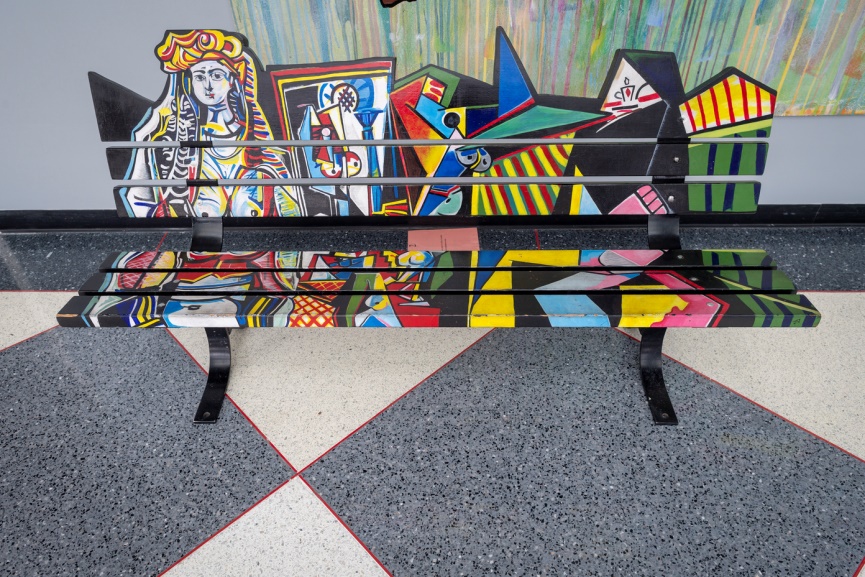
After School Matters Benches (Chicago O’hare Airport)

Located throughout the Terminal 1/2 Bridge and Terminal 5, the After School Matters Benches depict various designs. All benches are hand painted by teen apprentice artists in the After School Matters art program. After School Matters is a non-profit organization that offers Chicago teens high quality, hands-on, project-based apprenticeship programs in a variety of content areas, including the arts, communications and leadership, sports, and STEM.


B is For

Beacons by Steven Heyman

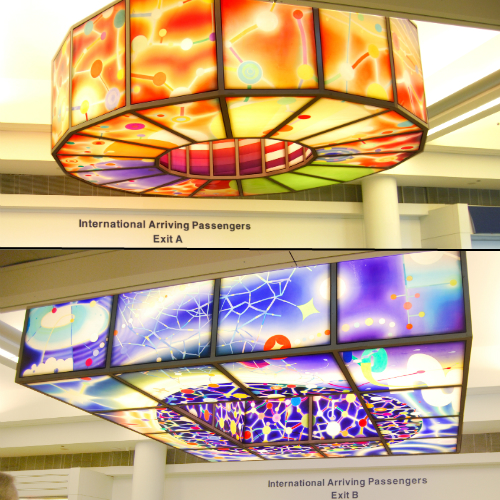
A large square “Blue Beacon” and a large circular “Orange Beacon” suspended above the “Meet and Greet” area in the lower level of Terminal 5. Illuminated with fluorescent lamps, they measure 16′ x 16′ x 4′. The artwork was commissioned in collaboration with the Chicago Department of Cultural Affairs Public Art Program.

Boeing Mosaic

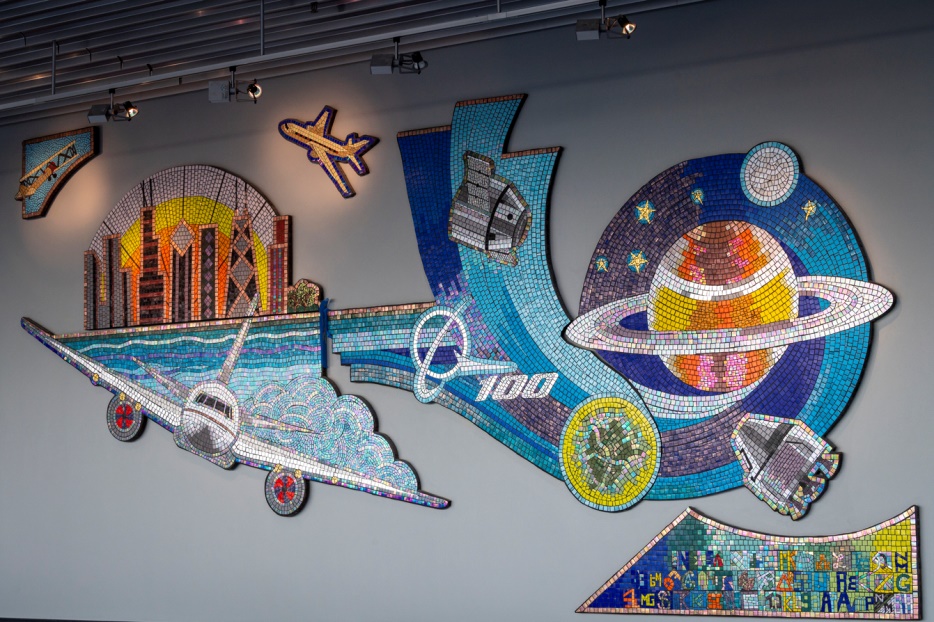
This mosaic piece, created by After School Matters teen apprentice artists, celebrates aircraft manufacturer Boeing’s 100th anniversary in 2016. The piece hangs in Terminal 3, in the hallway between the Rotunda and H1. After School Matters is a non-profit organization that offers Chicago teens innovative out-of-school activities through science, sports, technology,creative writing and the nationally recognized gallery program.


C is For

Chicago Sister City Flags (Chicago O’hare Airport)

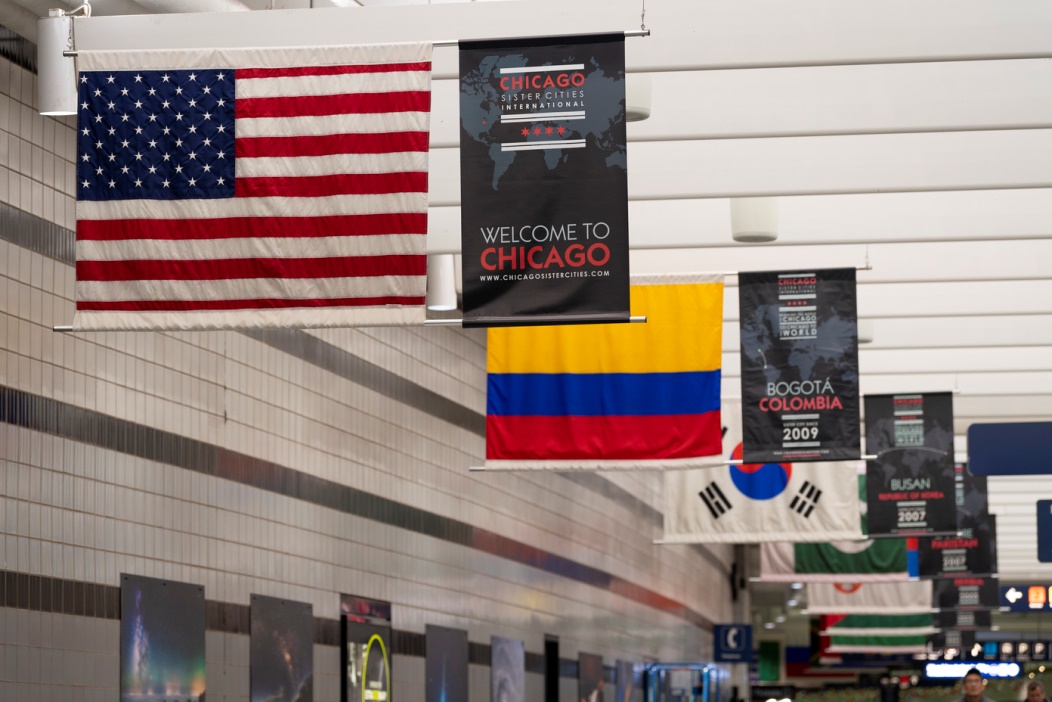
Representing the nations of Chicago’s Sister Cities, the flags are presented with help from Chicago Sister Cities International. Public art in and around Chicago’s O’Hare International Airport; January 2020.

City Windows by Qiao Xiaoguang (Chicago O’hare Airport)

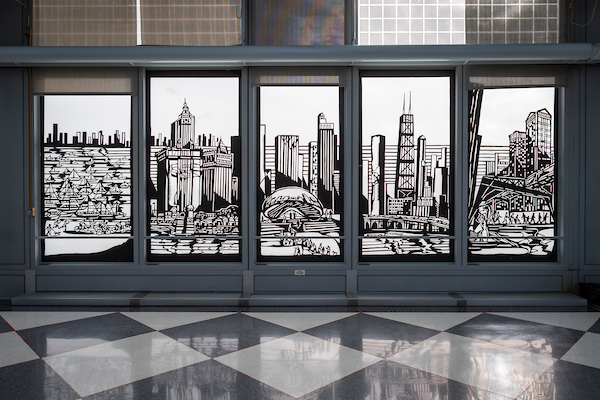
Created using ancient Chinese paper cutting techniques, City Windows depicts iconic sites from Beijing and Chicago. The piece commemorates the friendship and cooperation between China and Chicago. It is located near Terminal 1 Gate B19.


D is For


E is For

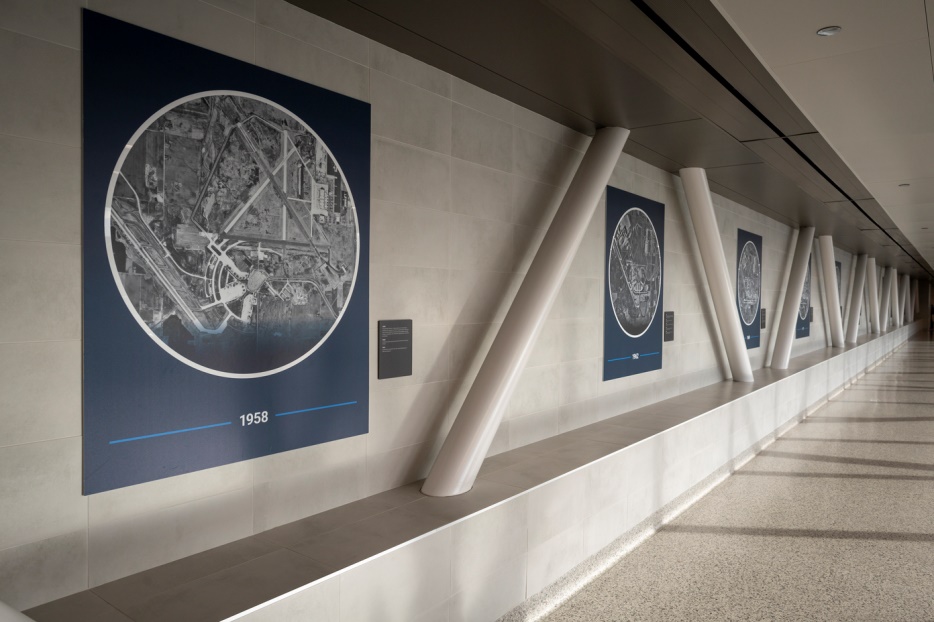
The Evolution of O’Hare (Chicago O’Hare Airport)

This gallery of aerial photos offers travelers a look at how the O’Hare airfield has evolved since it opened in 1945. A timeline of historical events accompanies each photo. The gallery can be found in the Terminal 3 L Stinger (Gates L20-24).


F is For

G is For

H is For

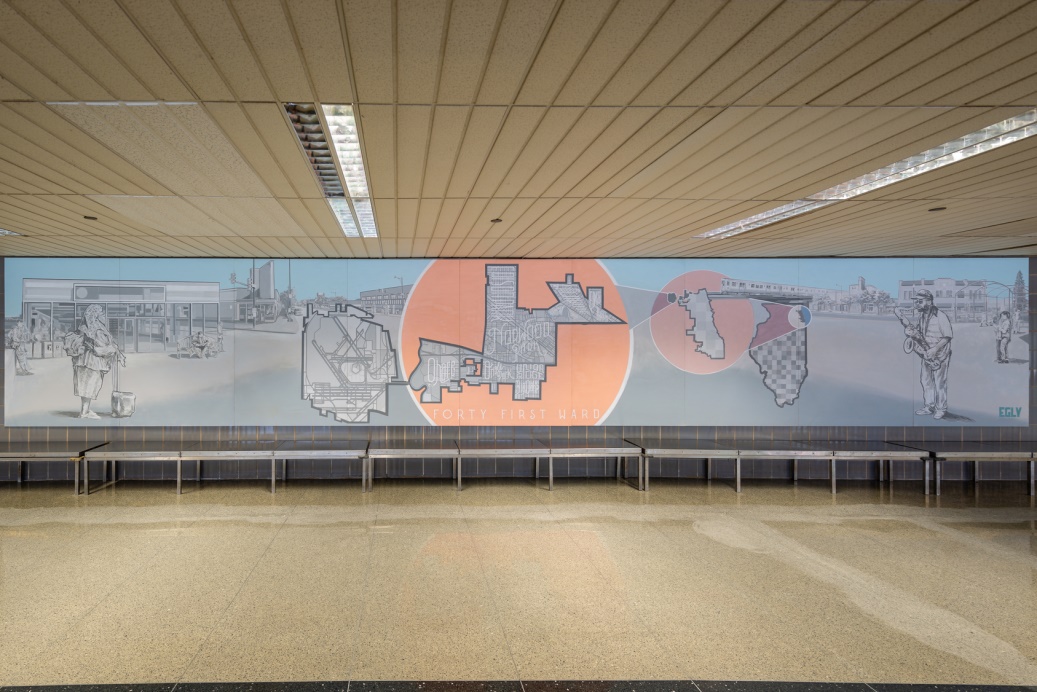
Here and There by Mitchell Egly (Chicago O’Hare Airport)

Created as a part of the City of Chicago’s 50 x 50 Neighborhood Arts Project and initiated during the Year of Public Art, Here and There is a visual representation of the many neighborhoods that comprise the 41st Ward, the Ward O’Hare is within. This piece was sponsored by by 41st Ward Alderman Napolitano’s office. It is located within the airport’s Bus Shuttle Center.


I is For

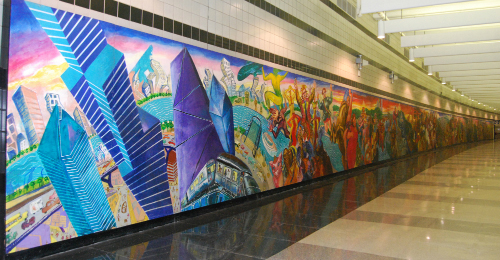
I’ve Known Rivers by Alejandro Ramero and Gallery 37  (Chicago O’Hare)

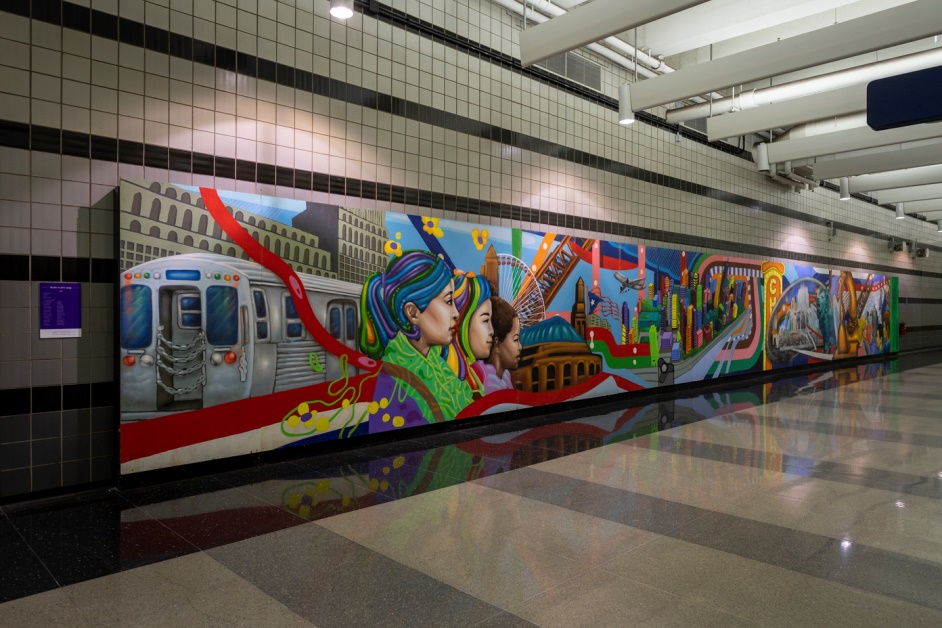
A 208-foot long mural painted in acrylics, that brings to life the words and spirit of the Langston Hughes poem of the same name. The mural, created by teen apprentice artists from After School Matters, is located in the CTA Pedway. After School Matters is a non-profit organization that offers Chicago teens high quality, hands-on, project-based apprenticeship programs in a variety of content areas, including the arts, communications and leadership, sports, and STEM.


J is For

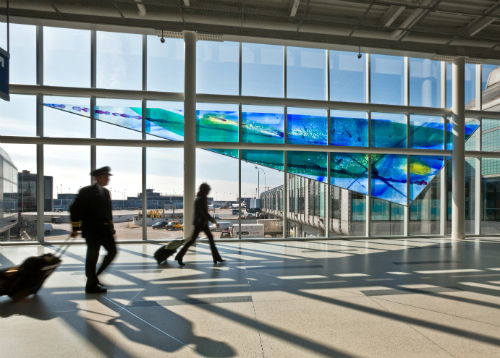
Jet Trails by Guy Kemper (Chicago O’Hare)

This sculpture measures 50 feet in length and 12 feet in height and consists of hand-blown painted glass in cool shades of blue, green and violet. The sculpture is suspended onto the window mullions directly across from Security Checkpoint 3 in Terminal 1 (past security).

K is For

L is For

M is For

N is For

O is For

On The Wings of Water (Chicago O’Hare)

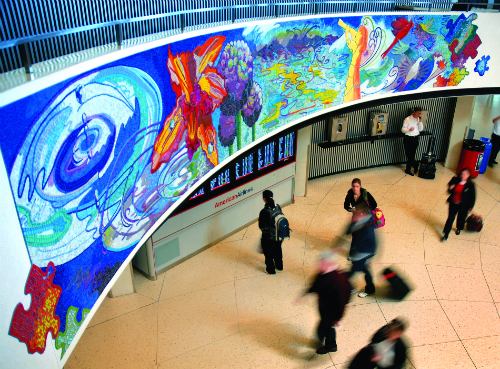
A 35,000-piece Venetian glass and tile mosaic shows how air travel and water link cultures across continents and between cities, towns, and rural areas. It was completed with the help of After School Matters student artists and can be found in the Rotunda between Terminals 2 and 3 (past security). After School Matters is a non-profit organization that offers Chicago teens high quality, hands-on, project-based apprenticeship programs in a variety of content areas, including the arts, communications and leadership, sports, and STEM.


P is For

Palimpsest by Nick Cave (Chicago O’Hare)

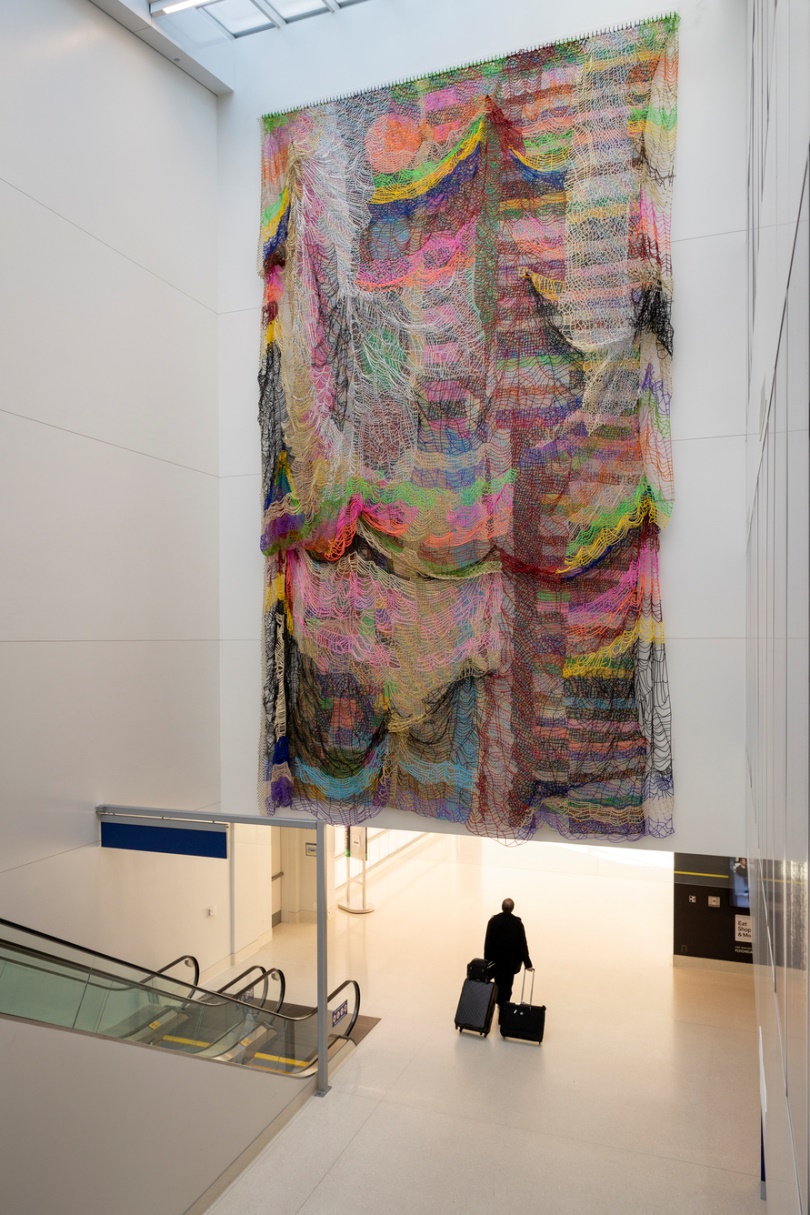
A dimensional tapestry constructed of hand-strung, beaded shoelaces woven with memory-steeped iconography and patterns through a nylon fishing net base layer. The piece represents a travel to understanding, the web of humanity, and future memories. Its colors come directly from Chicago’s unique skyline and is a continuation of the greeting a visitor takes in through their airplane’s window as they begin their decent for landing. It is located within the airport’s Multi Modal Facility.


Q is For


R is For

The Runners by Theodoros Papagiannis (Chicago O’Hare)

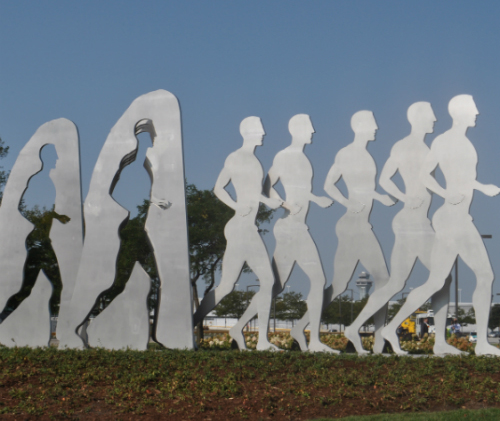
The Runners, a 16-foot sculpture, is located along the I-190 south side embankment and can be seen by motorists and CTA Blue Line riders exiting the airport. Donated by the Athens Committee of Chicago Sister Cities International and supported by Chicago’s large Greek-American community, the sculpture depicts five runners emerging from antiquity into the modern world. A maquette of this same piece is located within Terminal 5, behind the Arrivals Level information desk.

S is For

77 Neighborhoods (Chicago O’Hare)

This photo exhibit, located in the Terminal 5 corridor approaching the US Customs and Border Protection Federal Inspection Services area, showcases architecture, life, and popular scenes from across Chicago’s 77 neighborhoods.

Skies The Limit (Chicago O’Hare)

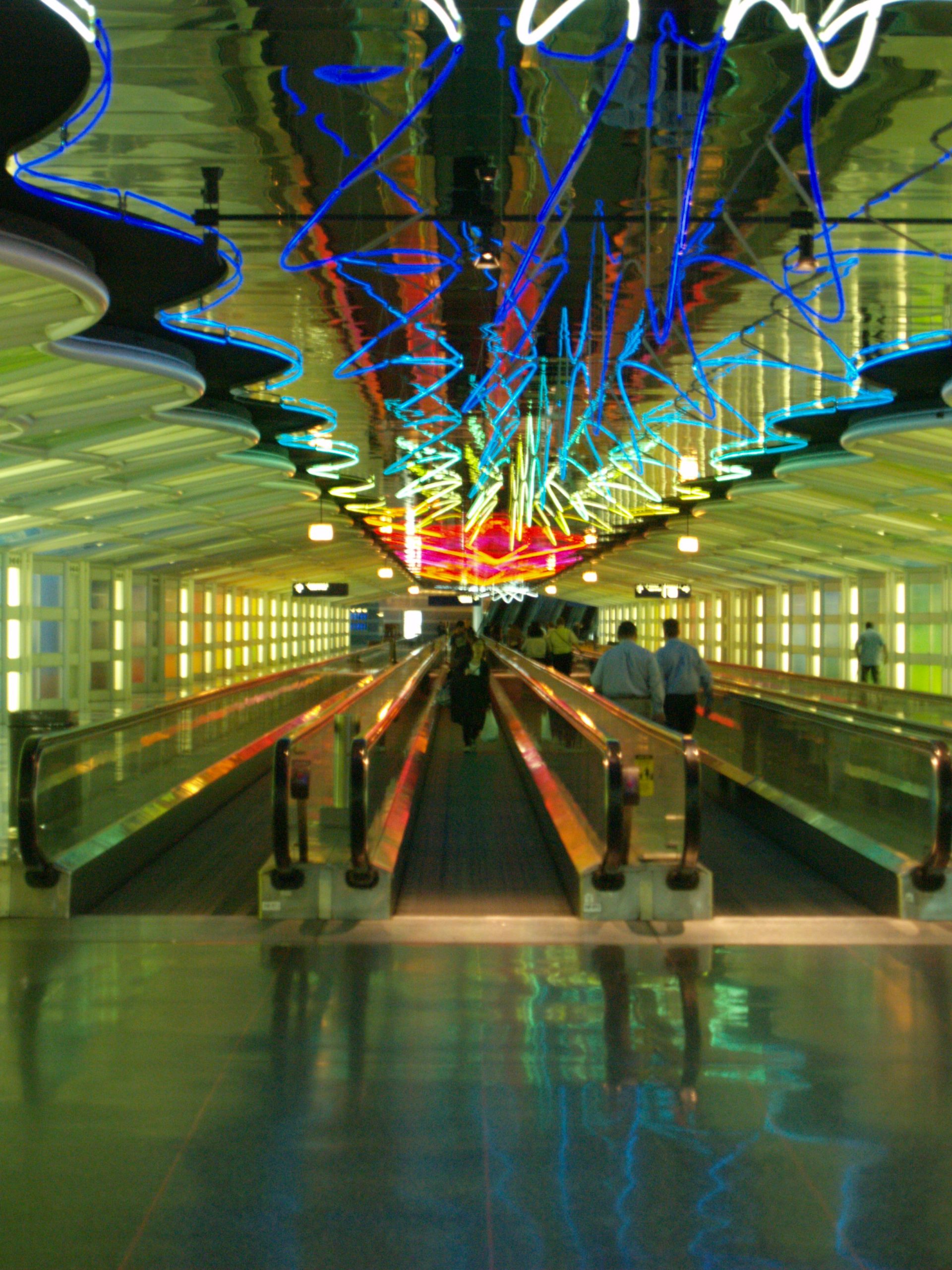
A multi-sensory sculpture which extends above the walkway connecting concourse B and C in Chicago’s O’Hare Airport.  The artist, Michael Hayden was commissioned by the airport in 1987 to design the 744 foot-long, neon kinetic sculpture which changes color in time to music.

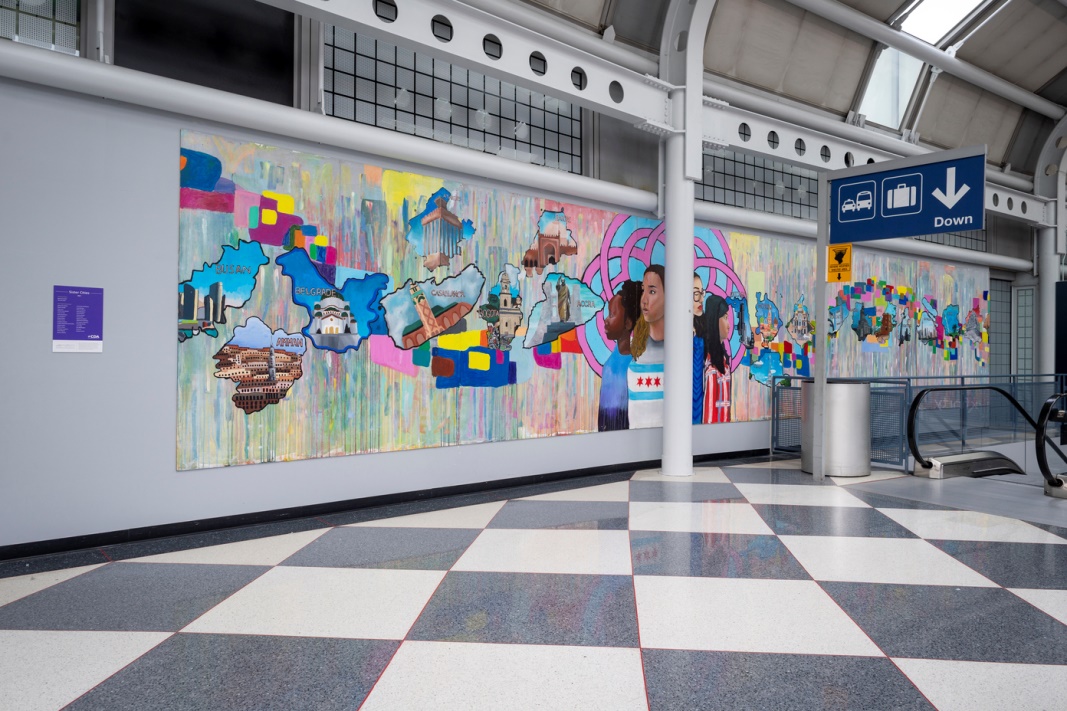
Sister Cities by After School Matters (Chicago O’Hare)

Inspired by Chicago’s numerous Sister Cities, the mural depicts scenes from cities across the globe. Teen apprentice artists from After School Matters created the piece. After School Matters is a non-profit organization that offers Chicago teens high quality, hands-on, project-based apprenticeship programs in a variety of content areas, including the arts, communications and leadership, sports, and STEM. It is located in the hallway between Terminal 1 and Terminal 2.

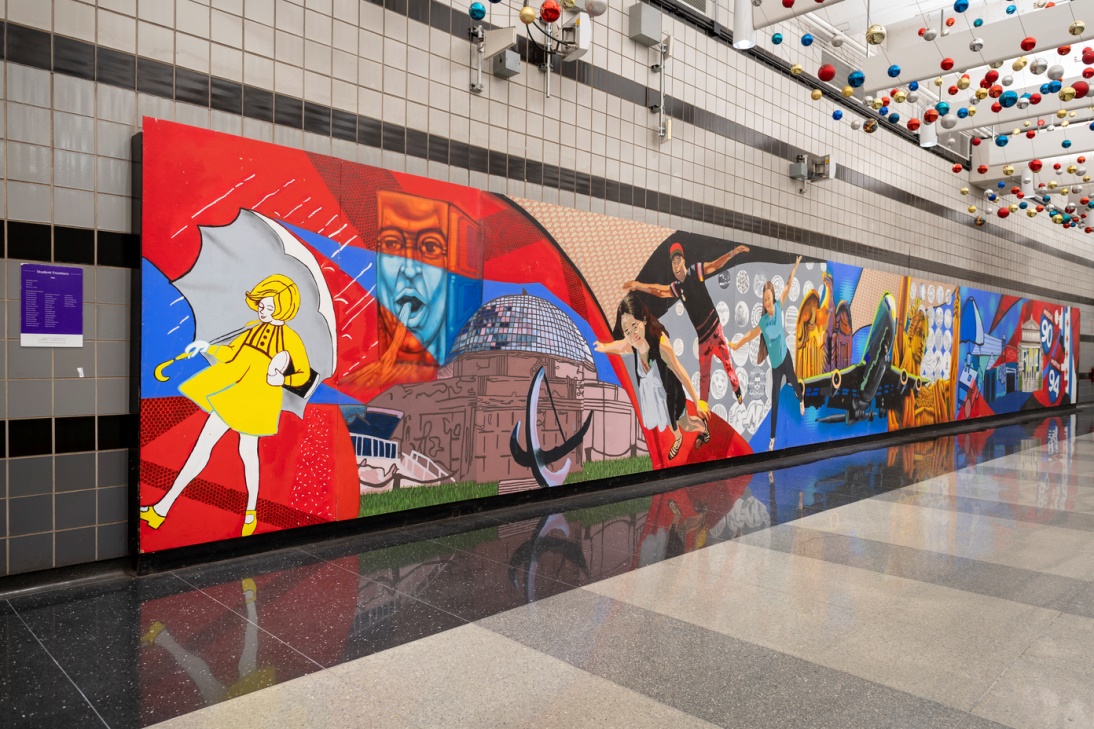
Student Frontiers by After School Matters (Chicago O’Hare)

Teen apprentice artists participating in After School Matters programs created this mural in 2016. After School Matters is a non-profit organization that offers Chicago teens high quality, hands-on, project-based apprenticeship programs in a variety of content areas, including the arts, communications and leadership, sports, and STEM. This mural is located in the CTA Pedway.


T is For

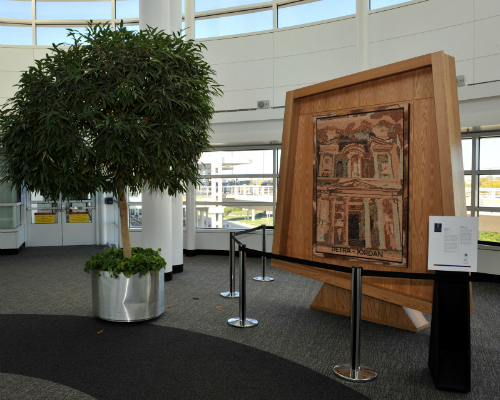
Treasury of Petra by Sonia Twal (Chicago O’Hare)

A limestone and marble mosaic donated to the City of Chicago from its sister city Amman, Jordan.  It can be found in Terminal 5 near Gate M14. The mosaic was inspired by the carved rock and stone facade of the red-rose city of Petra in the southern Jordanian desert. The limestone and marble used in Twal’s representation were obtained from the Petra region.

U is For

V is For

W is For

X is For

Y is For

Youth in the Loop by After School (Chicago O’Hare)

Teen apprentice artists participating in After School Matters programs created this mural in 2015. After School Matters is a non-profit organization that offers Chicago teens high quality, hands-on, project-based apprenticeship programs in a variety of content areas, including the arts, communications and leadership, sports, and STEM. This mural is located in the CTA pedway.

Z is For

“T” is for Tips and Tricks-ABC’s of Airline Travel

Here is a list of our best tips for airline travel:

  • When booking your flight, allow enough time between connecting flights. We usually strive for 1 ½ hours.  Generally this allows for minor delays.   If we are traveling internationally, these layovers may involve clearing customs and security.  In this case we allow between 2-2 1/2 hours layover because we must claim our bags and go through the security check all over again.   In either case, we look to see how many more “chances” there will be to catch another flight, if for some reason our connecting flight gets cancelled or delayed.
  • Choose your seat. I prefer knowing where I am going to sit.  I want to be with my family if possible.  My husband has very long legs, so he must always have an aisle seat.  If we can upgrade to gain a for a few more inches of legspace, we often do so.  Websites such as seat guru can often tell you the advantages and disadvantages to choosing certain seats.  Surprises such as finding you are sitting next to a bathroom, or that the seats don’t recline, can make travelling a very unpleasant experience.
  • Download airline/airport apps. These can help you see gate changes and flight delays.  The airport apps often offer layouts for each terminal.  Knowing where you are going if you are rushing can save precious minutes.
  • Purchase or borrow luggage which can be pulled or pushed. Carrying heavy bags when you are also having to run for a flight is never easy.  A backpack is also a good option.
  • Check size and weight restrictions of luggage before flying. Realizing you are 1 lb over the limit and getting charged an extra $50-$100 because of it is a sure fire way to start off on the wrong foot.  The same is true for oversize luggage. Many airlines have overall dimensions of luggage.  This is the length x width x depth.
  • Know how many pieces and what constitutes a personal item. Carry on luggage may be subjected size and weight restrictions.  Again, this helps to avoid those extra charges.   Some international flights are very specific about what constitutes a personal item.  Small commuter planes often don’t have the ability to store even regular size carry ons (see gate checking luggage).
  • Place a contact sheet and itinerary page inside each suitcase and carry on. This is usually the last thing I pack so that if the case is opened, it will be the first thing someone sees.   If my luggage is lost, this simple piece of paper will help reconnect me with my bags.
  • Label all luggage on the outside. Use a luggage tag, or one of the tie on pieces located at the check in desk.  For safety, your personal information should be covered (the tie on tags fold and tuck).  If you are shopping for luggage tags, look for the kind with a security flap.
  • Pack all prescriptions in original containers. Always carry your prescription medication in your carry on.  If this is not possible, make sure to have a few extra days of the medication in the carry on.
  • Pack your carry on as if you might need to gate check your case. Full flights often run out of overhead storage.  When this happens, the remaining passengers will be asked to gate check their luggage.  Always remove your id & passports and anything else of importance if you are asked to gate check.  Gate checked luggage is different than normal checked baggage.  The carry on items will be tagged and stored in a special location on the plane.  Ground crew will deliver the luggage to the walkway once the plane lands.  Unfortunately gate checked luggage is not tagged to move on to your next destination, so if there are challenges with the machines/people who are unloading it, it can make you late to catch your next flight since you must wait for this luggage.  This is what happened to about half the plane on our last flight, after the hydraulics broke on the lift which bring the bags up.  I have never seen so many angry people.
  • Having a foldable shopping bag packed on top of your luggage or in a side pocket is helpful. This can be a store bought pouch or a paper shopping bag.   If you are forced to gate check your carry on, this bag allows you to transfer your most needed items quickly, just remember this is going to go under the seat in front of you, so take only your essentials. *Always keep cash, ID, passports and prescriptions with you.
  • Before leaving for the airport, think about how you will dress.  Dress for speed. No underwire bras (they set off the alarm and almost guarantee a pat down).  Easy to remove jackets or cardigans are easier than those which need pulling over your head.  Slip off shoes ae easier than lace ups (remember to wear footies if you are not wearing socks, you don’t want to stand in that line barefoot…yuck).  *Always wear shoes you can run in…you never know when those gate changes are going to happen or when your flights make a connection very close.  If you want high heels or flip flops, carry them in the carry on and change once you reach your gate.
  • Dress in layers. Planes can be too hot and too cold.  Extra clothing can always double as a pillow.
  • Speaking of pillows, they do not count as luggage.  If you find you don’t have enough space in your carry on, you can put a coat, clothing or other soft items in a zippered pillow case.  This will serve multiple functions as you travel.
  • Arrive 2-3 hours before your flight is scheduled to depart. In large international airports, you may need every minute of this time to clear security.  Smaller airports may only need 1-1 1/2 hours.   If you find yourself with extra time, go shopping, get a bite to eat, look at art or hang out in a lounge but don’t stress yourself by arriving at the airport late.
  • If you are parking a car, write down your parking space number and/or take a photo with your cell phone.  You will thank me when you return.
  • Always carry some cash. If you become stranded at an airport or while en-route, there is never a guarantee that ATM’s and/or online credit card systems will be functioning. Depending on how far I am traveling, how many overlays I have and where I am going,  I usually carry enough to pay for a meal, a car rental and a hotel room.  (Generally about $50-$250).  There is a limit to how much cash can be carried (usually $10,000) , so make sure to declare it, especially if you are transiting between countries.  When declaring your cash, be sure to include travelers checks and cashiers checks.
  • Carry some food and snacks. If a flight is cancelled, you may find yourself overnighting in an airport.  Stores may be closed.  If a flight is delayed and sitting at a gate or on the tarmac, there will be no food/drink service.
  • Pack a USB charger. Our phones carry the equivalent of a computer these days.  They replace cameras, MP3 players and books.  They carry our calendars, address books, maps and more.  Having them functioning at all times can prevent a lot of stress. There are many ways to use up your battery on a cell phone…photos, reading,  listening to music and/or watching movies.  Having a USB charger allows you to recharge while waiting for a flight and/or if your flight is delayed.  The charger can often be used on the plane too.  Just toss one in the carry on, you will be happy you did!
  • Check in online when possible. This helps to prevent standing in line.
  • Pack liquids and gels in a see through quart sized zip lock bag. Place the bag towards the top of your carry on case or in an outside pocket for easy removal.  You will be asked to remove these if you do not have Global Entry.
  • Pack electronics toward the top of your carry on. You will be asked to remove these if you don’t have Global Entry.
  • Choose the furthest left queue in the security line, it is generally less busy.
  • Remove jewelry, belts and jackets before you get in line, or while standing in line. Don’t be “that” person who slows the process by not being ready to move through security.   All of these items can be placed inside luggage if you have room.  Otherwise follow the steps below:
  • Remove your passport and boarding pass (these are carried through the scanner).
  • Place jackets and coats in the first bin.
  • Place electronics (laptop, Ipads, Kindles etc) in  a separate bin.
  • Place shoes and wallet/purse and jewelry together in the last bin, that way you will never forget to pick up your wallet and valuables.
  • Send your luggage through the scanner.
  • Once past security, purchase or fill a water bottle. Hydration is the best way to combat jet lag and helps to prevent airborne illnesses.
  • Consider purchasing coffee or tea before boarding the plane. The water on the plane has been stored in large containers which are never cleaned.  This is the wate tea and coffee are made with.
  • Listen for announcements. It is easy to pass the time by plugging into headphones but miss the announcement of a gate change and you can be left running.
  • Watch for changes around the waiting area. Did everyone suddenly leave?  You better check the departure board.


When you have done all that you can to prepare, you can sit back knowing that you are ready for “almost” anything.  Enjoy your stress free vacation