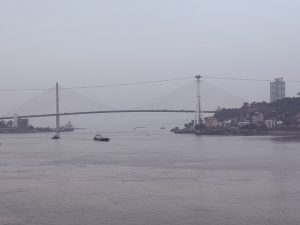
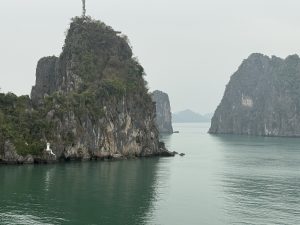
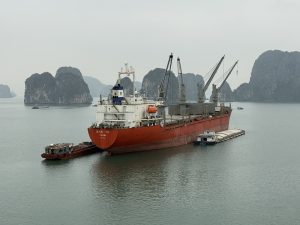
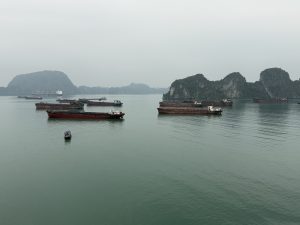
Sometimes our ABC game just doesn’t line up in alphabetical order, such was the case with our time spent in Na Trang, Vietnam. Today’s activity actually took place on March 30, 2026, a couple of days before Halong Bay. Today was a welcome late start. We would be on tour from 9:45-3:15pm. One of our shorter adventures.
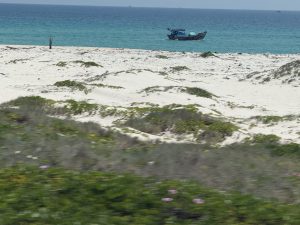
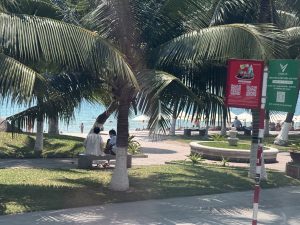
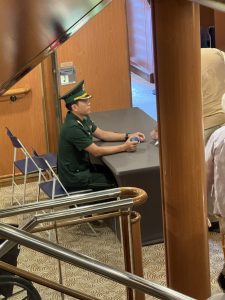
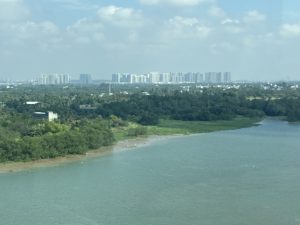
We ported at Cham Ran, which is a military base. As we disembarked, we were repeatedly warned that no photos were to be taken, until outside of the military zone. We would be under constant surveillance until we were off the base, which ran for about 20 miles through some of the most pristine waterfront and beautiful forest that I have ever seen. I would say that the military here enjoys some pretty fine accommodations along the pure white sand beaches! These photos were taken just beyond the base.
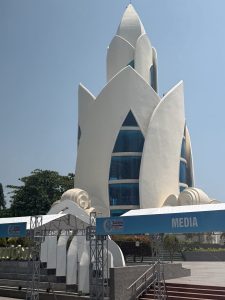
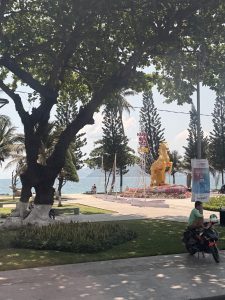
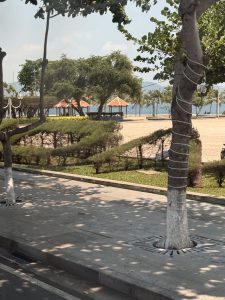
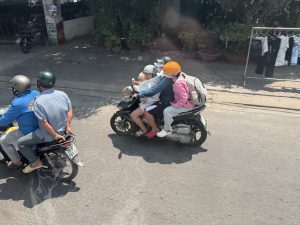
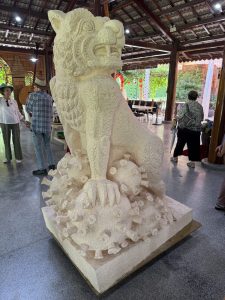
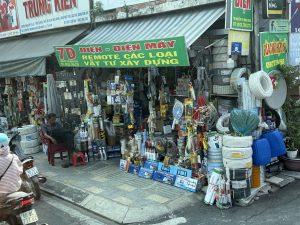
Once outside the base, we entertained ourselves along the one and a half hour journey to Na Trang by simply observing outside the bus window. I will be eternally fascinated with the motorbikes of Vietnam. On this day we saw an entire family, including a child eating ice cream and carrying the pet dog, on one bike. We also saw fascinating architecture and beach front sculptures. I was intrigued to learn that the beaches are mostly used by tourists.
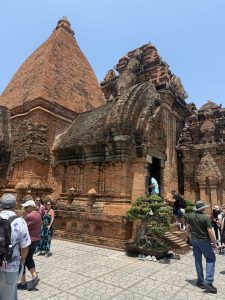
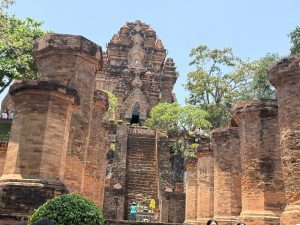
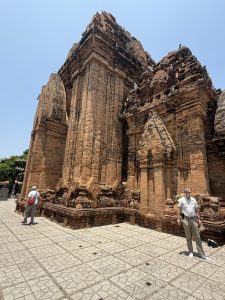
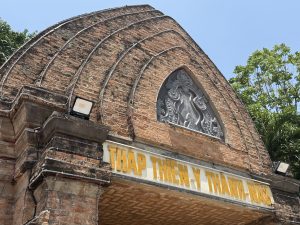
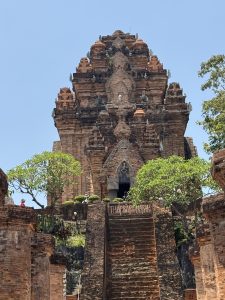
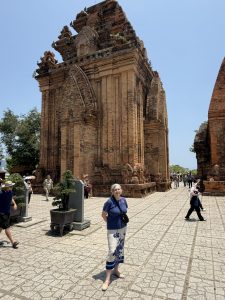
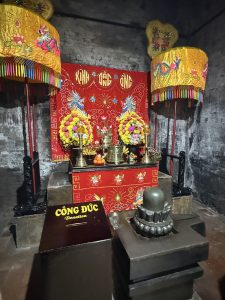
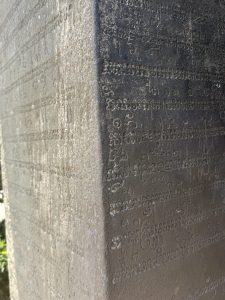
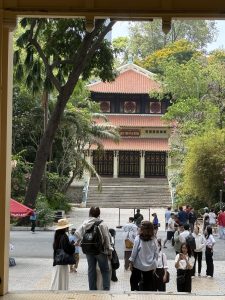
The highlight of this excursion was going to be the Po Nager Cham Towers. The word Ponagar means “the mother of the country”. Perched on a steep hill, overlooking the Cai River, the Ponager Cham Towers are a 1,000 year old Hindu complex, which were built to worship the Queen Po Ina Nagar. According to the Cam people, she was the” goddess of creation, coming out of the clouds and sea foam to give them bountiful harvest, as well as a peaceful life”. Surrounded by mountains, rivers and natural beauty, one can understand why the towers were built here. Originally there were more towers but only 4 remain today. In 1979, Ponagar Tower was classified as a national monument. This has now become a popular tourist destination.
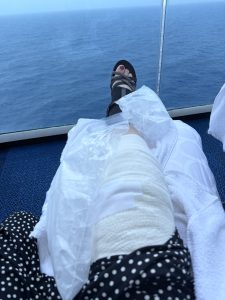
I had been so excited to see this stunning architecture but as luck would have it, fate had different plans for me. As I took my final step at the top of the steep entrance, I fell backwards (flipped actually) down the stairway leading to the towers. There were so many people on the stairs, we will never know if I missed my footing, or if I was knocked backwards. Thankfully Alan was quick on his feet and ran below me to catch me, preventing a much more serious injury than the fractured foot and sprained knee ligament that I incurred. We still had a full day of touring ahead of us and not wanting to go to a foreign hospital, I carried on until I could go to the onboard medical facility, upon our return to the ship (about 4 hours later). I managed to hobble my way through the Cham Towers, but unable to bear much weight, the knee and ankle soon began to swell and hinder my ability to move very far.
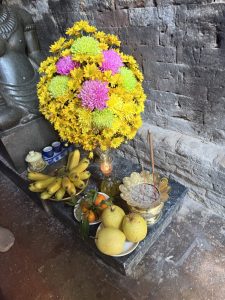
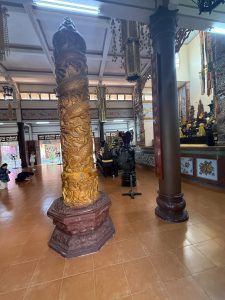
The temple at the tower was filled with flowers, fruit and incense. Due to its small enclosed space, the scents were overwhelming to many of the visitors. I was fascinated by all the details in this architectural masterpiece. The temple’s central image is a 1.2m tall stone statue of the goddess Yan Po Nagar sitting cross-legged, dressed only in a skirt, with ten hands holding various symbolic items. No photography of the deity was allowed.
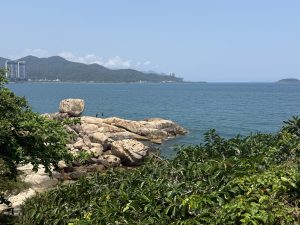
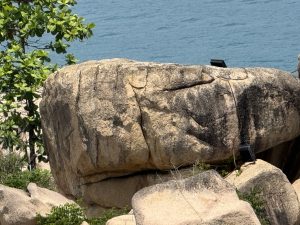
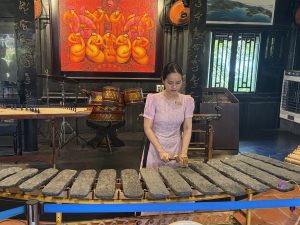
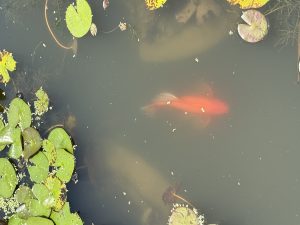
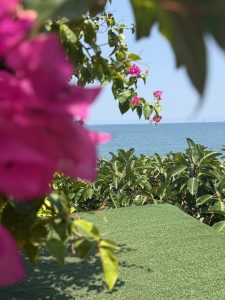
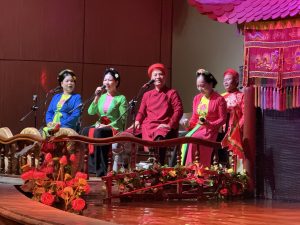
Following our visit to the towers, we went to the Hon Chong Promontory. This is a unique rock formation of stacked rocks which jut out into the harbor. There are two clusters of rocks. One is called Hon Chong which means husband in Vietnamese, the other is called Hon Vo, meaning wife. I was unable to venture to the rocks, so Alan volunteered to go ahead, to see if he could locate the giant five-fingered hand print embedded on a boulder. According to a folktale that has been passed down for generations, a giant man was fishing here, when a giant fish swallowed him and pulled him away. The man tried to pull himself back to shore, while tightly holding a fishing-rod in one hand and pressing the other hand against the boulder, which left the imprint we see today. Alan was unable to get down to the handprint in the time allotted but enjoyed visiting the promontory. In the meantime, I was gently exploring the waterfront building leading to the rocks. There was a group playing traditional Vietnamese instruments and I was quite content to sit and listen to them as I watched the koi in a nearby pond and simply enjoyed the flowers which seemed to surround this area. Alan wasn’t willing to leave me alone for very long so he soon rejoined me.
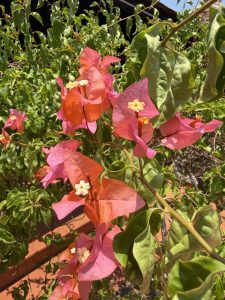
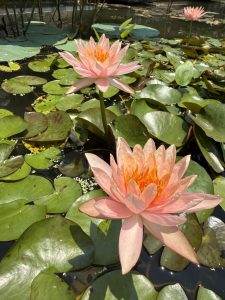
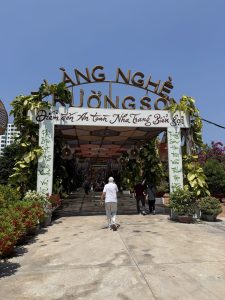
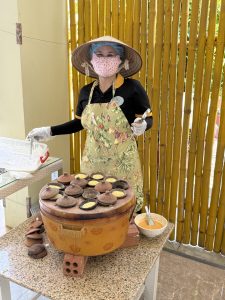
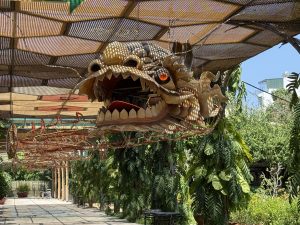
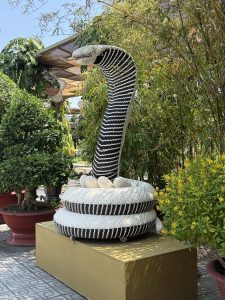
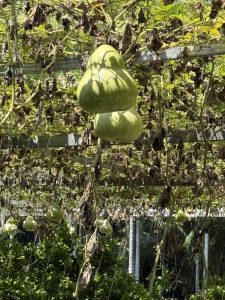
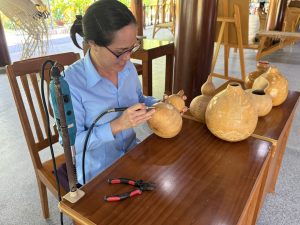
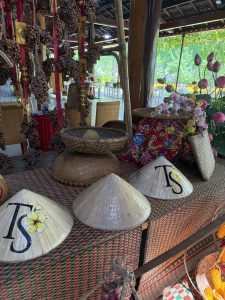
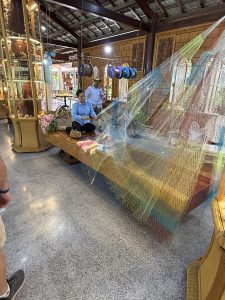
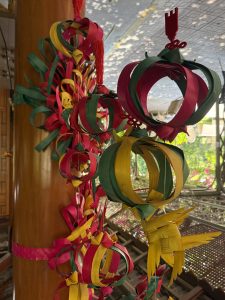
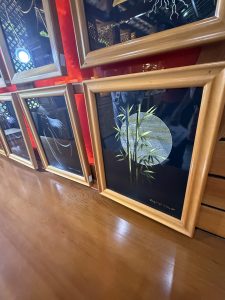
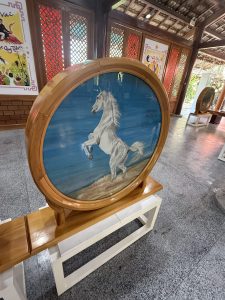
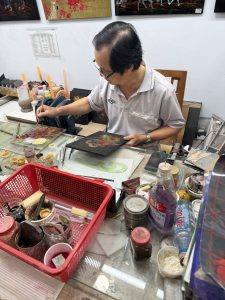
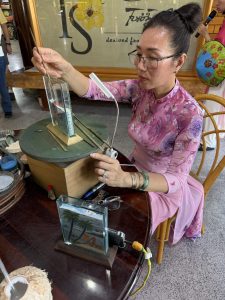
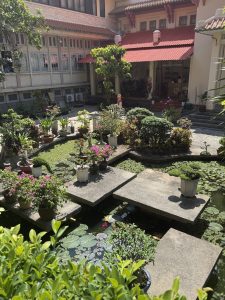
By now, we were already halfway through our day. Lunch was next. Considered a hidden gem, we arrived at the Lang Nghe Truong Son Cultural Village. First we experienced a massive Vietnamese buffet, with every kind of unique food available. I especially enjoyed the stuffed pancakes. We moved from the buffet through a courtyard filled with interesting animal sculptures and peaceful gardens into the craft village. Visitors to the Craft Village can see the artisans weaving mats, making hats and knitting nets. We also observed artisans making sand paintings and carving gourds.
Our next stop of the day was the Dam Market. By now my ankle had swollen considerably. I did not feel like bumping into people or getting stepped on in a crowded space, so Alan and I opted to sit outside and enjoy a refreshing drink from a local vendor. Knowing I was heading to medical as soon as we arrived back, I used the time to fill out an incident report. The tour guide wasn’t very happy that I had fallen.
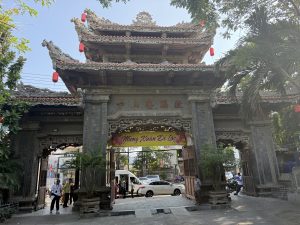
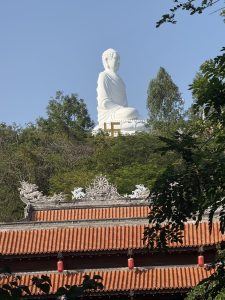
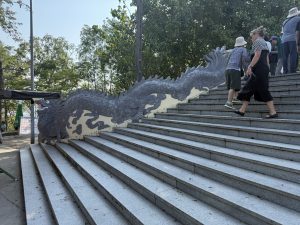
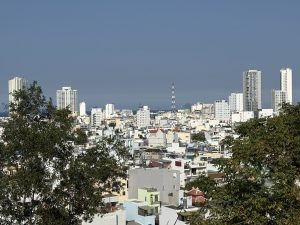
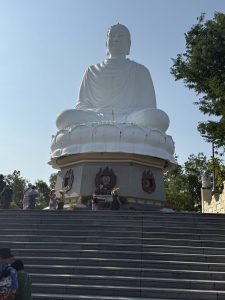
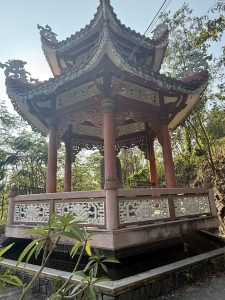
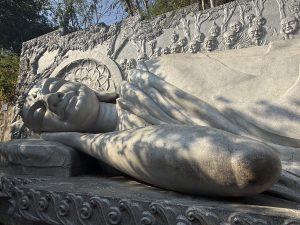
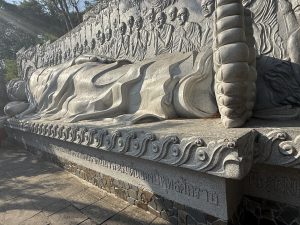
Our final stop was the Long Son Pagoda. Owning several Guinness World Records and considered as the largest pagoda in Nha Trang, Long Son Pagoda is worth visiting once in a lifetime. The huge white Buddha towers over the city of Na Trang and is visible from quite a ways away. This was another impressive highlight which I was going to have to sit out, as it required conquering 193 steps to the top of the hill. The temple itself was built in 1886 and has seen many wars that left a mark on it. The temple is now the center of the Vietnam Buddhist Studies Foundation, where many monks study in its premises. Alongside the sitting Buddha statue on the hill, the temple grounds also house the reclining Buddha, also known as the “sleeping Buddha.” I am so grateful to Alan for completing the mission, just so I could enjoy the photos.
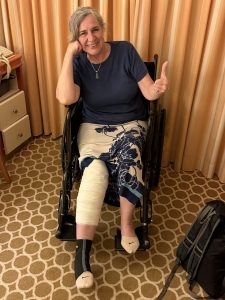
From here, we headed back to the ship. The hour and a half drive passed quickly. Upon returning to the ship, I immediately hobbled my way to the medical bay on the 4th deck, where I spent the next hour being x-rayed and prodded, confirming that I had a fracture of the foot and a badly sprained knee. The knee was immobilized and a compression sock was placed on my foot. I left the medical bay in a wheelchair with strict orders to stay off my foot/knee and pack it in ice for at least the next 24 hours. Thank goodness we had a sea day the next day.
Health Update: This injury would prove to be more serious than originally thought. I had actually fractured my foot in two places, including the talus bone, one of the hardest bones to break in the body. Upon returning home from this travel adventure, I was immediately placed in a walking cast for over 6 weeks. This was followed by months of physical therapy 3 times a week. Due to the complex tears in the ligaments and tendons and my connective tissue disease, I was warned it will take over a year to recover from this injury.
My advice? Travel everywhere but don’t roll down stairs and always carry travelers insurance!
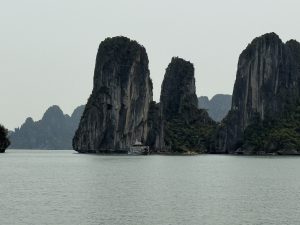
We fell in love with the idea of cruising Halong Bay, when our friend Sherri, cruised there last year. The otherworldly scenery, of limestone pillars rising out of the waters in the South China Sea, had called our name ever since. This area is also dedicated as a UNESCO site. Truth be told, much of this cruise had been selected for the itinerary, which would give us 2 full days to explore this region.
The name Ha’ long means “descending dragon.” Legend says, the dragons were sent there by gods to protect Vietnam from invaders. The dragons spit jades and jewels to the sea which later turned into the islets and islands. These 1600 islands created a protective wall to shield against enemies.
With 600 boats registered to explore the area, choosing the right tour for yourself is really important. It can be very busy but knowing where the boats go, there are still quiet places waiting to be discovered. Almost every trip offered will include a tour of the islands, a cave tour and sometimes kayaking, with a stop at a pearl farm or floating village.
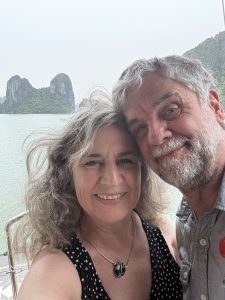
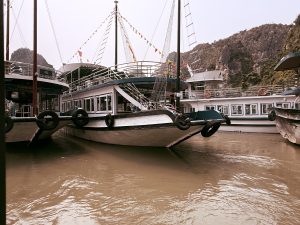
Yesterday we had been meant to sail through the area on a traditional junk boat. A naturalist would be on board to describe the conservation process which is being done to save the stunning karsts (islands) rising out of the water and the work they are doing to regulate the massive surge in tourism to the area. The limited amount of port time would only allow us the chance to explore on our own for a day, which is plenty really. We were going to be visiting zone 4, which is one of the most unspoiled areas. This area is usually reserved only for the very wealthy or for tour boats on a 2 or 3 day cruise. When our cruise line suddenly changed the excursion time of the water puppet show, by a 4 hour difference, we thought we might have to eliminate the cruise around the islands. All was not lost, we just detoured and found a shorter excursion and were still able to do both activities, during the time we were in port. It just meant a little less time around the islands and we only made it to zone 2, My Dr. had wanted me to cancel the entire day and rest a little longer. I decided if I could get on the tour boat, I would prop my foot up and enjoy the ride. Our cruise ship would remain in port overnight and depart at 7a.m. the next morning. This had allowed us to take in the water puppet show during the evening.
Most of the Halong Bay tours include a tour to a cave. Some offer time kayaking and may visit an oyster farm or floating village. Because we were on the shortened version of the trip, our excursion would only include the island tour and cave tour.
Alan would have to explore the cave on his own. I was so proud of him for continuing to complete the tours even when I couldn’t.
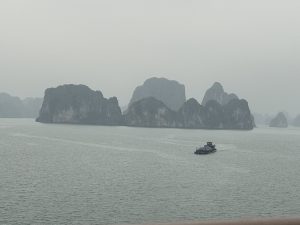
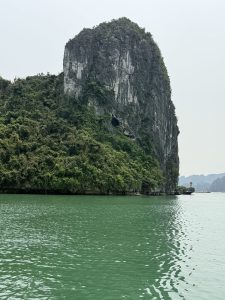
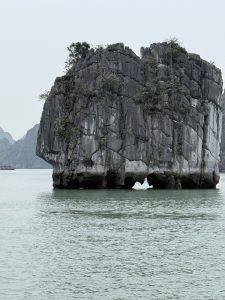
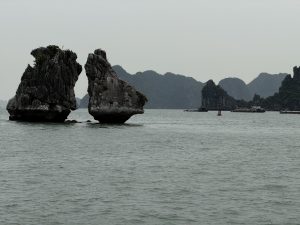
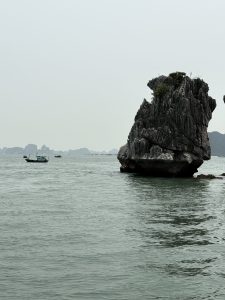
The next morning we set off at 7am and began to slowly work our way through the islands and eventually sail out to sea. This is called “scenic cruising” and when we are lucky enough to have it on an itinerary, it can be some of the most spectacular scenery of the entire trip. Our second day in the area of Halong Bay did not disappoint. There were many interesting sites to discover along the way. Many of the islands have names such as chicken rock and whale rock.
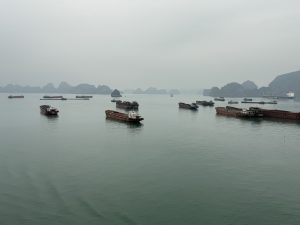
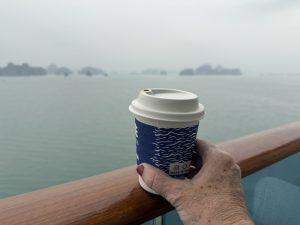
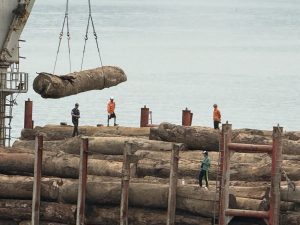
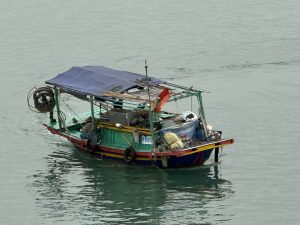
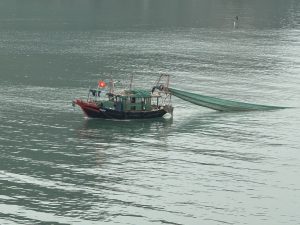
Even though we had seen a lot yesterday, I woke early to watch the sunrise before we set off, unfortunately it was another cloudy day. As we moved out to sea, we had an entirely different perspective than we had, had the day before. There were many interesting things happening in the bay. I was fascinated with the logging and fishing boats. There was a sort of market out here as people sold their produce directly from their boats. It was a slow day for us, as we passed the time on our balcony, watching the world go by. We simply let nature work its magic. In this place, at this moment, there are no politics, there are no worries. On this 50 square foot space of our balcony, we can pretend we are alone, as we quietly move further away from the populated areas, watching the unspoiled beauty of the placid waters and vegetation covered karsts, as we sailed out to sea. This is the reason we always book a balcony cabin. We are so grateful to be here, to experience the magical beauty of this amazing place.
Vietnam has been such an interesting country so far. When we plan our trips, we start out with a huge wish list of ideas and Vietnam had been no exception. Due to time constraints, our list had quickly whittled down to the most important must see/do activities, in what limited time we would have in each of our 4 ports. The hours are even more precious while on a cruise, because it may be difficult to reach inland cities and return to the ship in a timely manner.
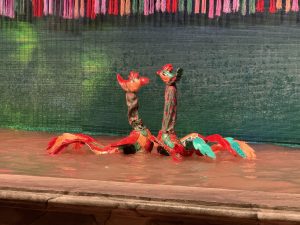
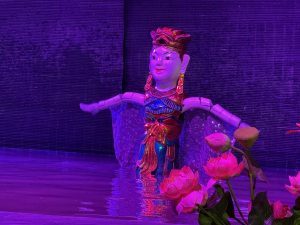
While puppetry exists in many countries around the world, water puppetry is exclusively found in Vietnam. Experiencing the 1000 year old art was very high on our “bucket list” but there are only a six professional puppetry troops, which still perform the ancient art. We had found shows in Ho Chi Minh City and Hanoi which were 1 ½ and 2 hours away from our ports respectively. Imagine my excitement when I realized that there was an excursion being offered, while we were in port at Halong Bay and it was only ½ hour away! A single opportunity to catch this very unique art.
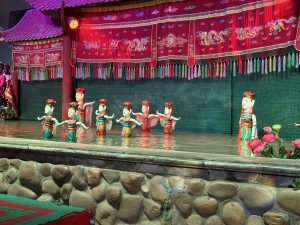
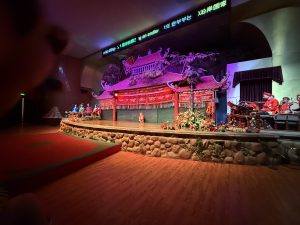
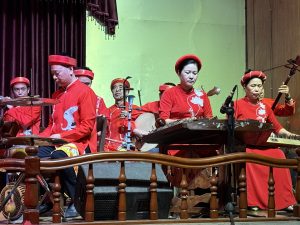
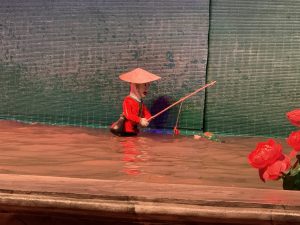
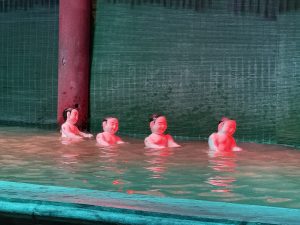
Water puppetry emerged in the 10th century, during the Le dynasty. Villagers in the Red River delta and other rice-growing regions of northern Vietnam, staged water puppet performances; to celebrate the end of the rice harvest, at religious festivals, or simply for entertainment. Today, the water puppet show is a small window into Vietnam’s culture, offering a glimpse into the traditional way of living. As we took our seats in the specialized theater, vocalists entered from the left, while instrumentalists came from the right. The puppeteers stood behind a screen. The stage was a 3 foot deep, man made pond, in front of the screen, representing the rice paddy field.
The stories portrayed reflect everyday moments of local people, including farming, fishing, and celebrating festivals. Value messages are conveyed through the wooden puppets about family, working together peacefully, honoring nature, and preserving traditional ways. All stories are told in Vietnamese but it is not difficult to figure out what the scene is about.
There are three ways to control the puppets. The smaller ones are attached to bamboo poles, rods, and strings which the artists tug at to move them around. The bigger puppets can weigh as much as 35 pounds each. With the larger puppets, the upper part of the puppets, or the body represents the character, while the base is attached to the underwater machines, The strings and machines are hidden by the water, which is why the water is usually a dark murky green. Complicated puppets like the dragon usually require a combination of both machines and manual techniques.
Our show was about 50 minutes long and included 8 short stories. By the time we came to the end of the performance, we felt that we had been fully immersed in Vietnamese folklore, music and language. This was a wonderful cultural experience.
Go on vacation and it is likely you will come home with some special keepsake. A great souvenir should transport you back over and over in time, to the memories made in a location. There is a great expression, “take only memories and leave only footprints”. This statement is perfect in its simplicity, when experiencing a natural area but visiting interesting locations and exploring unique cultures, warrant gathering items which help us to remember. Like many, we came home with treasures to add to our home. Some cost a lot, others cost nothing. Space, weight and budget may dictate what item or items are worthy of our making their way home in our suitcases, so let me tell you about a few of our favorite things to collect.
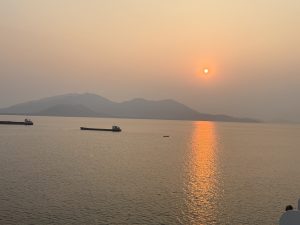
A sunset in Vietnam
There are so many keepsakes which cost little to nothing. It will come as no surprise that my number one souvenir will always be my pictures and my written words. My first suggestion for travelers is to take as many photos as possible, while allowing yourself to be fully immersed in your experience. There is a saying, “if you don’t have a picture of it, it never happened”. You can always delete photos which don’t turn out well, but you can not recreate those special moments, which show how you have spent your days and who you shared your time with. My official photo count for this 30+ day adventure is over 10,000 pictures! These days, cell phones make taking pictures easy. You will never regret reliving the memories through your photos and stories.
I will delete many of these images but a few hundred photos will become priceless treasures. These will be added to our digital photo frame at home (our number one treasure in our house), allowing us to relive our experiences over and over, initiating conversations, as we reminisce. Our 4 year old grandson especially enjoys the photos on the frame and often makes up his own stories about our pictures, while telling us he has “been there”. We love fueling his imagination and we hope to inspire his dreams of visiting these exotic locations for himself one day.
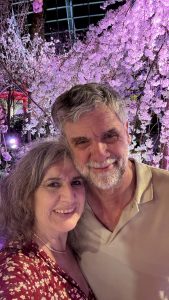
Sometimes it is not “what” we collect in our travels that we consider a souvenir, but the stories we gather along the way. Photos become a documentation of how you are spending your time but a photo rarely stands alone without an explanation. Alan and I are always playing the ABC game, so we are often looking for unique activities and adventures to experience. In the past, we have designed ABC adventures around using different modes of transportation, visiting cities and tasting various alcohol laden drinks along the abc trail. We even completed an airport art adventure, using the alphabet as our guide! Our photos often reflect the goofiness we get up to, as we try to document each letter under our selected theme. We are both trying to get better at selfies!
“Us” at Gardens by the Bay, Singapore
If you think of a camera as a way to capture your story visually your creativity will naturally flow, I am the designated photographer for our family. I still don’t consider myself a great photographer but I am pretty good at documenting our lives. It wasn’t always this way. When I met Alan, he was the one exploring photography but once kids came, I became passionate about capturing them on film, scrapbooking and story telling, which meant I spent more time behind the lens than in front of it. Alan and I are always together, we are a team and most of our photos represent that but I also want my children and grandchildren to have photos of each of us as separate and unique individuals. If you are the photographer, remember to step out from behind the camera occasionally. You are part of the story too!
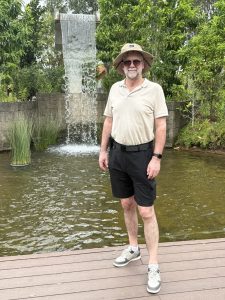
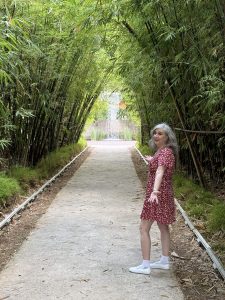
Exploring Chinese Gardens in Singapore
This brings me to my next souvenir freebie. A journal costs nothing to keep. A few sentences about the things you ate, the people you met, the weather and the experiences you had, will be great memory joggers as you revisit your moments. You can use the notes feature on your phone, an app or good old pen and paper. The most important thing is to write down some details. This is the only way I would ever remember that every student in Hong Kong is required to choose an English name for themselves. This tidbit certainly makes my writing more interesting but it also offers more depth to the photos we take.
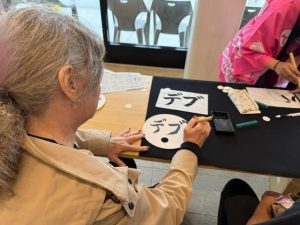
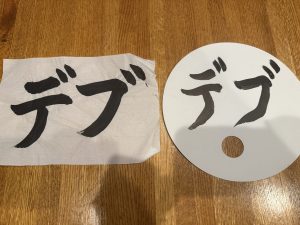
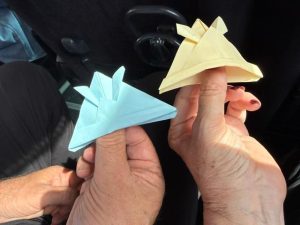
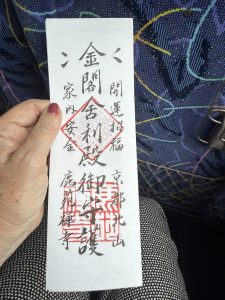
Memorabilia is also something easy to acquire. While in Japan, I spent a few minutes learning to write my name in calligraphy. I may frame this work of art but if I don’t, I will always remember how fun it was to learn. On several of our Japanese excursions, we also learned the art of origami folding. We made Mount Fuji and a Samurai helmet. One of our tour guides also gifted us a tiny, folded, origami heron. These are small treasures which were also documented by photos but if I choose to keep the items, they can easily be added to scrapbooks or journals. Another favorite piece of memorabilia was an entry ticket to the Golden Pavilion in Kyoto, Japan. It is beautifully written calligraphy which offers a wish for family safety and safe travels. This is worthy of space among my story telling. Currency can also be a form of memorabilia. While in Vietnam, we were millionaires as we carried 9 million Dong, the equivalent to a little less than $350!
Learning to write in JapaneseMy name in JapaneseSamurai origamiOur entrance ticket to the Golden Pavilion
Let’s explore some of our inexpensive keepsakes, these were all conscious purchases. My first rule for myself when collecting keepsakes is that a souvenir can’t take up space in a junk drawer, only to be donated to charity in a couple of years…you know the kinds of trinkets I mean. With so much mass produced “stuff”, we have to be selective about what to give space and weight to in our luggage.
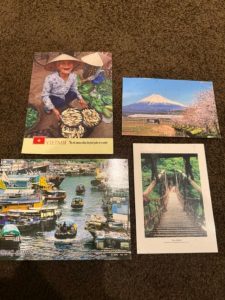
The first is the simple postcard. I try to write as many as possible while on our adventures. Hand written notes to friends and family are quickly becoming a lost art. Getting up to 30 cards written and in the mail, when you only have a single day in a country, is an adventure in itself and content for a different blog post. The adventures which have been created around first finding a postcard, writing them, then getting stamps and finding a mail box are story worthy. I mailed a card from each city we visited to our 7 year old granddaughters, first grade class, so they could follow our adventures. The teacher turned these into a lesson by having each child draw a photo from their favorite location and tell us what they had learned. This by far became my favorite keepsake…like I said, it’s the stories which are the real meaning of keepsakes and I can only imagine how wonderful it will be for our granddaughters classmates to get these tiny works of art and their own stories back at their graduation. I also take time to write postcards to myself. Since I know the post person is sure to read it, I usually try to put something funny on the back, regarding our adventures. So far she has never commented but I like to imagine the joy she gets when she realizes I am really talking to her. When I get home, I attach my postcards to a ring which gives me a mini diary of the things we have done. The best thing about postcards is that many areas are restricted for photos but often there is a postcard from a professional and the pictures are always better than anything I could take. Besides, if I lose my pictures, these are great backups. Sometimes I will buy a postcard as mini pieces of art. Framed, these can be quite beautiful.
Postcards sent to myself.
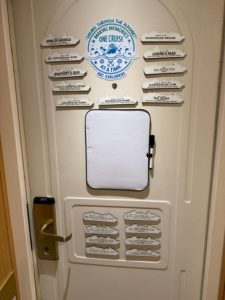
Cruisers are notorious collectors of magnets. They are a small and inexpensive item, which generally decorate the cabin doors and sadly they are often stolen from said doors. We collect magnets in a different way. Instead of gathering magnets from each location, I have personal magnets made for each of our cruises. These tiny wooden ships represent the ship we sailed on, the dates and locations we traveled to. I keep them on the magnetic walls of our cabin when we sail and on display in our home when we are there. I never realized how much joy a tiny collection could bring. Every time I pass the ships, I am reminded how fortunate we have been to be able to travel and I am filled with gratitude at the opportunity.
Our custom made cruise magnets.
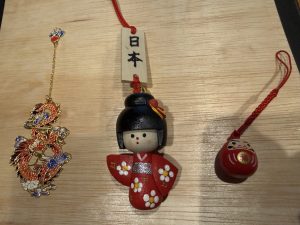
I have also always collected Christmas ornaments from the places we visit. Now that the kids have left home, our tree has become travel themed. This is another of those adventures worthy of its own story, especially in countries which don’t celebrate the Christian holiday. It has become quite the experience to find a meaningful and tiny item which can be repurposed as an ornament. Ornaments do not need to be typically Christmas themed to earn a spot on our tree! On this trip I repurposed a bookmark from Taiwan to become an ornament. I chose a Kokeshi doll which represents friendship or love from Japan and I also bought a tiny Daruma figure which is a Japanese good luck charm, to help us realize our dearest wish.
New Christmas ornaments
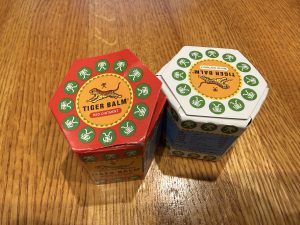
Cosmetics, toiletries, creams, lotions, soaps etc are other small items which can easily be tucked in a corner of luggage. Of course I had to pick up these tiny containers of Tiger Balm, while in Singapore.
Tiger Balm
This brings me to our next category of keepsakes which are slightly more expensive and bulky. The first is home decor. Alan and I are really not collectors of anything specific. We are also seriously trying to downsize, so Alan’s first question anytime I want to add something large is always, “where are you going to put it”? Our home decorhas always had a global influence but most of the pieces came through the now defunct Pier One store and have never really meant anything. Our current travel adventures are now taking us to the exotic places we have only dreamed of discovering, giving us opportunities to gather really unique and meaningful items, the kind we want to talk about.
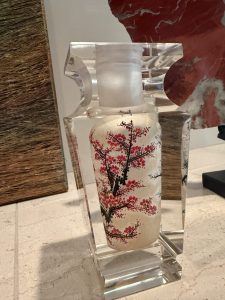
On long trips, we must also pace our spending. On this journey, we would be visiting 7 countries and many interesting cities, each with their own cultural specialties. I had to decide if I wanted one really unique piece from Asia, or different items from each country. My first keepsake was acquired at the beginning of our journey, in Chinatown, located in Singapore. This was our first destination. My treasure was a beautiful vase,inside a vase. It is hand painted from the inside, using tiny brushes. It was expensive, heavy and was going to require hand carrying home. It was going to be awkward, as it was very fragile and could only be taken in hand luggage but it was something I just had to have. The artist is no longer alive, so these pieces are fairly difficult to find. I decided if this was the only piece I ended up bringing back, it would be a wonderful addition to our home. Fortunately I didn’t blow all of our souvenir budget!
Hand painted vase
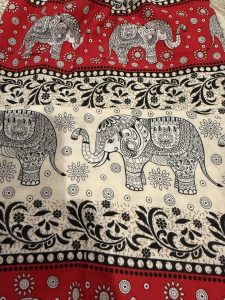
Clothing can also be a wonderful souvenir . Our next destination was Thailand. I had already made up my mind that I was coming home with a pair of elephant pants, because I hadn’t brought any home the last time we were there and I had always regretted it. Elephant clothing is likely mass produced for tourists. Business was certainly brisk in the shop where I picked mine up. Any male or female trying to enter the Grand Palace in shorts, dresses above the knee etc, were required to purchase a pair… guaranteed sales! Colors and patterns are so varied, there is no limit to the combinations available. There were dresses, short sets and shirts with elephant prints, but by far the elephant pants, with their billowing legs and elasticated ankles are the hot commodity. It was humorous trying to find a pair of Asian sized pants, to fit a 6ft 6in man from our tour group. Stories are what keepsakes are all about and as I wear the breezy pants in our 90 degree days, I am instantly transported back to the joy I experienced in this wonderful country and the many friends we made while traveling and yes, we saw the elephants!
Elephant pants
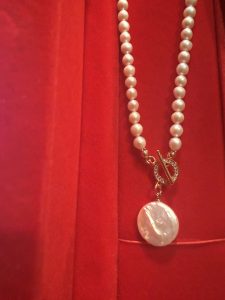
By the time we hit Vietnam, I was reminding myself to look for smallish items, since we were already close to our weight limit. Jewelry tucks in nicely in almost any suitcase. At a specialized craft market, I found a pretty, hand crafted, pearl necklace to bring home.
Pearls
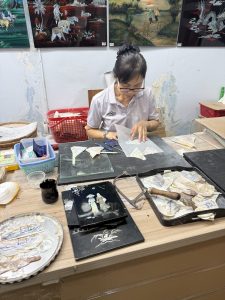
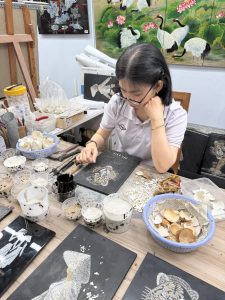
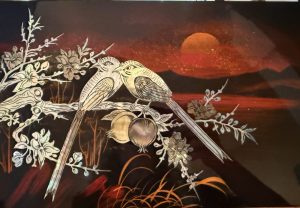
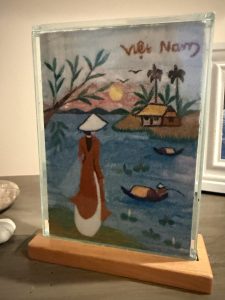
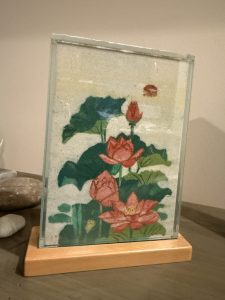
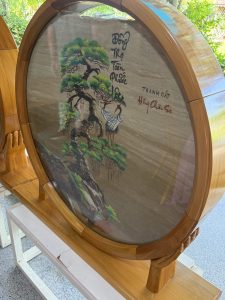
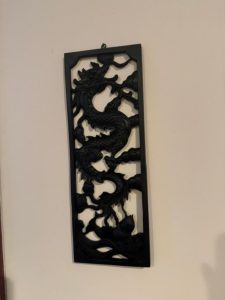
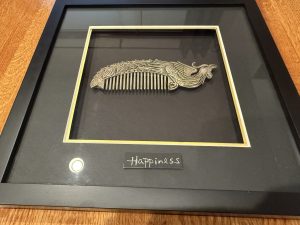
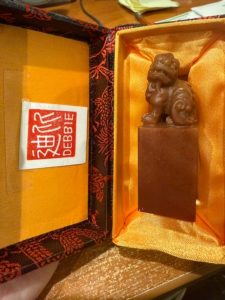
Lately we have also been looking for local art to bring home. Vietnam was a smorgasbord of opportunities. We opted for three art pieces from this country. Each item represents a craft style, unique to the areas we visited. Lacquerware is a real specialty in Ho Chi Minh city . As shells and paint are meticulously laid between seven layers of lacquer, it can take months to complete a single picture. We chose a small picture of two birds (we called them lovebirds) to commemorate our trip. Our second item came from the craft village in Na Trang. Sand art is not unique to Vietnam, but I have never seen two photos created at the same time, on opposite sides of an acrylic block! In Hoi An, I picked up a wooden carving of a dragon. The local artist sat among his carving tools in a tiny shop no bigger than a shed. He wrapped my purchase in a Vietnamese newspaper which could have been a collectible in itself. In Hong Kong I found two special gallery shops as the Stanley Market. The first was a tiny shop filled with beautiful stamps carved from stone. I chose a foo dog. These mythical lions represent power, prosperity and protection. Within a half hour, the stamp master had engraved my name and personal Chinese “chop” into the bottom of my stone. This treasure is an art piece in itself, but also a nod to my writing, as I begin to put my own “stamp” on things. From another quiet gallery, tucked way at the back of the Stanley market we found a shop selling unique pressed paper art and framed artifacts. This is how I ended up with an antique silver phoenix hair comb, encased in a shadowbox frame. With the single word, “happiness”. It seemed indicative of all which we experienced on this journey. The Chinese phoenix, or Fenghuang, set atop the haircomb, was often given to symbolize a happy marriage.
Artists at work
Our “lovebird” lacquer art.The artist making my sand art painting.Front side of the painting.Back side of the paintingHere’s the one I couldn’t afford. It is about 3 feet across!Wooden carving
Antique phoenix haircomb Chinese “chop” with my name
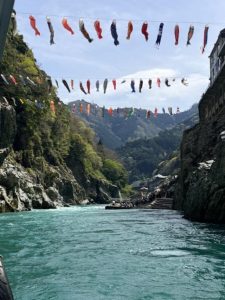
As we reached our final country of Japan, I was really beginning to worry about space and weight in our suitcases. We had now purchased several fragile items. What I had most hoped to represent with my keepsakes was the customs and culture of each country. When we sailed down the Yoshina River, through the Iya Valley, we saw these colorful, fish shaped windsocks being flown across the Oboke Gorge. Families fly them in a celebration held on May 5th, to represent family and wish for their children to grow up strong, brave and healthy, just like the determined carp, swimming upstream. These are called koinobori, or carp streamers. They have a permanent display at the gorge. I loved what they represent and knew that they would soon decorate my own dock, at home. These were the last items packed into our suitcase.
Koinobori streamers
Every room in my home is quietly telling the stories about our lives. Our stories have changed from our frugal beginnings as newlyweds, to parents, to grandparents and now to world traveling retirees. The items we collect are a reflection of us. Items don’t have to be branded, or expensive to earn a position in our home. They don’t have to be particularly significant to anyone but us. The word souvenir comes from the French verb “souvenir” which means to remember.
A journey, as defined by an AI search, is “the act of traveling from one place to another, typically implying a long, adventurous, or significant trip, rather than a short commute.” Today was the first of four cities we would explore in the country of Vietnam.
There are only five countries which are officially communist, Vietnam is one of them. Communism in its simplest explanation strives to eliminate the gap between rich and poor by sharing resources based on the principle: “From each according to his ability, to each according to his needs”. We wondered if we would feel any difference based on a vast contrast of ideology between our two countries. This year, Vietnam is said to be strengthening its security and police forces. Our first observation was the visitor entrance stamp we were each given by the on board immigration official, as we departed the ship.
We had docked in the busy port city of Phu My, which is about one and a half hours away from Ho Chi Minh City, formerly known as Saigon. With more than 10 million people, Ho Chi Minh is the most populous city in Vietnam. Normally, I’m not a fan of city tours but due to America’s involvement with Vietnam, this one felt more obligatory to visit than others.
I was young in the late 1960’s and early1970’s, when the images of war were telecast all day on our black and white television. My only awareness of Vietnam before this trip was through the lens of the Vietnam War and how it relates to Americas history. To this day, the war is largely not discussed in the USA and therefore my knowledge of this country is still fairly limited. Saigon (now called Ho Chi Minh city) was the headquarters for U.S. military operations during the Vietnam war.
Although there are many historical tours offered, I was not necessarily on a mission to do an American history tour. Like all of the exploration we take, I wanted a bit of everything, some culture, some history and plenty of things to photograph. I expected the constant noise, smells and motorbikes normally associated with what I knew about Vietnam but I didn’t realize how touched I would be at the grit and endurance of the Vietnamese people. I spent the hour and a half bus journey with my nose pressed to the windows, watching as we passed through small villages. The streets were alive as sidewalks doubled as barbershops, scooter parking and cafes. I was struck by the number of people selling items from their bikes and motorbikes, many of which chased the bus from location to location, in a desperate attempt to make an additional sale or two. Capitalism seemed alive here and countered my understanding of communist countries. There are indeed rules in this communist country, but they seem very relaxed. The tour guide explained that they have a lot of freedom, except political. The ruling party tolerates no opposition, no free press and no real public dissent. Ultimately, the message is, don’t criticize the communist party and you will mostly be left alone.
The port city eventually gave way to rice paddy fields and a host of oil and rubber tree plantations. Crossing the Saigaon river, Ho Chi Minh city finally came into view. From afar it gleamed with modern buildings, it was another moment that conflicted with my preconceived notions. Formerly known as Saigon, the city was founded in 1698 and was once part of Cambodia. In 1862 it was colonized by the French. The Vietnam war was a long battle between the north and south. America held a military presence here for nearly 20 years. When the Vietnam War ended in 1975, the North Vietnamese claimed victory over the South. Saigon was a symbol of the reunification of the country and was renamed Ho Chi Minh City in 1976, to honor the late communist leader Ho Chi Minh. Many older Vietnamese people still call it Saigon.
Our tour today included only the briefest explanation of America’s involvement but what I found most interesting was the evolutionary and cultural journey we unknowingly took, as we traveled through a timeline of Vietnamese history. At the end of the day, it would take a long re-evaluation of my notes to realize what we had seen and done and how interconnected it had actually been. Unfortunately our tour guide didn’t really offer that connection and I would be left to my own research to piece together the value of what we had seen.
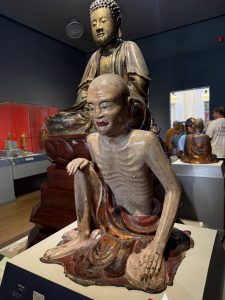
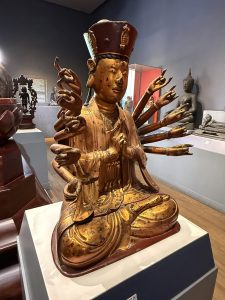
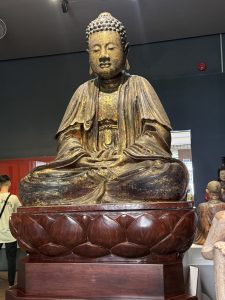
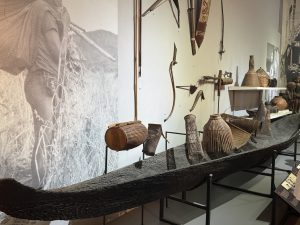
We were first taken to the National History Museum of Vietnam. During the French colonial rule, the beautiful building was originally built as a branch of the French School of the Far East. The architecture is a combination of Colonial French and Vietnamese. While not a fan of big cities, I am also not a huge fan of museums. They do serve the purpose of consolidating education into bite sized pieces. This museum covers from the prehistoric era to the August 1945 Revolution when the Democratic Republic of Vietnam was founded. This spring a new exhibit was introduced called “Spring-The Dawn of Victory”, covering the era from 1946 to present. Our time here was limited to just an hour, so as we began our cattle prod tour for the day, we only had time to explore a few exhibits and our guide did a poor job of educating us to the “why” we were seeing those areas. I did enjoy photographing some of the amazing artifacts on display.
Basically the museum represents two regions, the north and the south, divided into two cultural areas who didn’t agree on anything and were in a battle with each other for thousands of years. When Saigon was renamed, there was great hope that the two areas could become unified. The museum reflects the goals of the intentions and future of the country of Vietnam. Admittedly, it was a good place to start our tour. Armed with a brief overview of history and culture we could now set out to better appreciate the city.
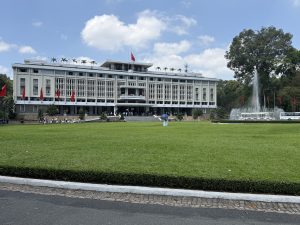
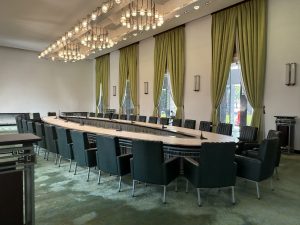
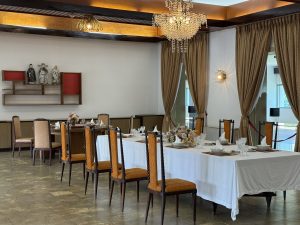
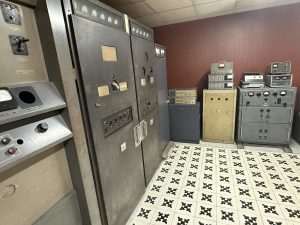
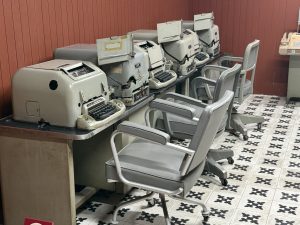
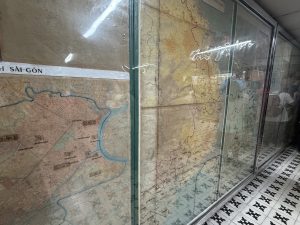
By mid-morning, the outside temperature was beginning to warm up to the 90’s, with about 90% humidity. We were thankful that our next adventures were indoors. The destination was a mid- century, architectural masterpiece known as Reunification Hall, also called Independence Palace. This building is as significant as a tour of our own White House. On the outside, the structure offers sleek lines, open spaces, and a design symbolizing power and authority, which is fitting since it was originally built for the governor. It would eventually become the command center during the Vietnam War. Each floor reveals its own stories. The ground floor holds the elegance and grandeur expected to host and entertain dignitaries, the first floor was for private quarters, the second for receiving and entertaining delegations and the third for quiet contemplation and personal leisure. The real interest for most people lies in the secret bunkers, war rooms and communication center located in the basement.
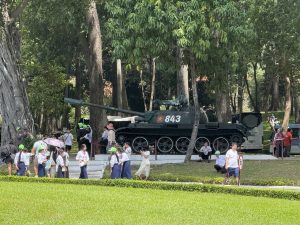
After a Liberation Army of South Vietnam tank crashed through the gates on April 30, 1975, the building has also been associated with the official end of the war, more commonly known as the “fall of Saigon”. Today the palace is preserved as a convention hall for state events and a museum.
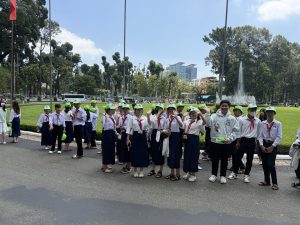
Sometimes while traveling, the smallest of moments creates the biggest of impacts. A group of students was waiting to tour the facility. They were actively trying to engage the Western looking tourists, They were so excited to meet an American and practice their English. I asked if I could take their photo. It was very touching as they blew kisses and formed hearts with their hands, sometimes communication is loudest in silence, a perfect example of the very barriers that travel breaks down. My heart was full as I engaged with these young ambassadors.
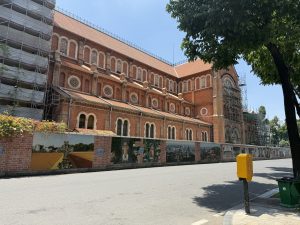
On our whirlwind visit, we had a couple additional photo opportunities and all of them involved great architecture, which is a passion of mine. Located in the center of the city, Notre Dame Cathedral of Saigon was built in the late 19th century, the cathedral features twin bell towers reaching nearly 200 feet high. The red brick walls were imported from France as were the beautiful stained glass windows. Unfortunately the building was covered in scaffolding, minimizing the grandeur of this great structure and my ability to get great photos.
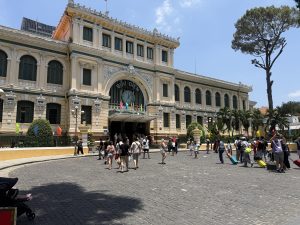
The French Colonial Post Office, built between 1886 and 1891 is located next door to the basilica. This was our next stop and a premier example of French Colonial architecture featuring a grand vaulted hall, patterned tiled floors and intricate iron supports designed to mirror European train stations. Everything about this space, from the original phone boxes to the massive circular counter, is interesting. This is a major tourist attraction, so people watching was just as fascinating as choosing a post card to send from this still operational post office. I could have spent significantly more time here, but we were limited by the 15 minute time frame we were given and I was on a mission to choose post cards and obtain stamps, so that I could get the cards written before leaving Vietnam. It turns out that the post office shorted the postage required for post cards and I had to chase additional stamps later in the week anyway! I will save the topic of mailing post cards, while on holiday, for a different post but let’s just say it is a labor of love when we are overseas! The area around the post office is also a wonderful open air market. For a brief moment, I wished I hadn’t been on a tour, so that I could just revel in the atmosphere of this extraordinary place.
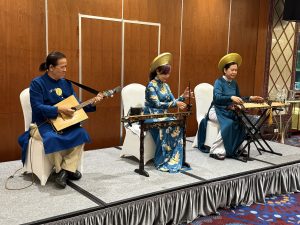
By now, we had worked up quite the appetite. The great thing about being on a cruise sponsored excursion is that meals are often at high end hotels…the kind I can’t afford to stay at but which lunch is a special luxury. This particular lunch was at the 5 star, Windsor Plaza Hotel. There was an added bonus that Western style food was served alongside all the traditional Vietnamese options, which made my husband very happy! In the wonderfully air conditioned grandeur of this place, we were serenaded by traditional music played on Vietnamese instruments.
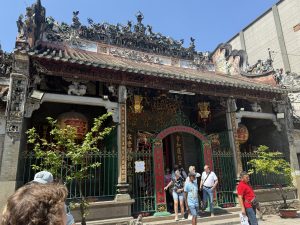
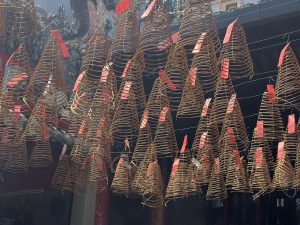
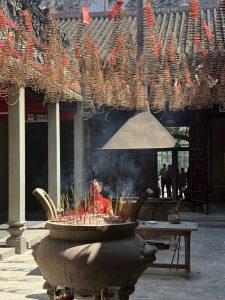
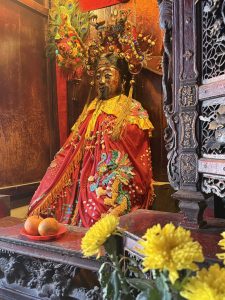
Our bellies once again full, we continued on our busy schedule. Our next stop was the Thien Hau Temple. Arriving as immigrants around the 17th century, a small population of Chinese, numbering between 750,000 to over 2 million, known as the Hoa people, settled in urban areas such as Ho Chi Minh. They brought with them their own rich heritage of traditions. Around 1760, the ornate temple was built to worship Thien Hau (Mazu), a Chinese deity. Thien Hau (Mazu) is the revered sea goddess. It’s said that her birth brought forth a sweet fragrance and radiant light. Gifted with magic, she flew over the ocean on a mat, to save those in danger. After passing away, she often appeared in red, gliding above the waves. She is one of the most widely worshiped deities among overseas Chinese, who journeyed across the sea to settle in new lands. The temple serves as a spiritual and cultural hub for the Hoa people, preserving their rich heritage and traditions for future generations.
Next it was time for a bit more culture as we toured the Dat Viet Lacquer Factory. Lacquerware is one of Vietnam’s biggest exports. This 800 year old traditional craft uses a natural resin from the son tree, to create a polished, durable and glossy item. Each piece takes months to create, as up to 30 layers of resin are often applied. The craftsman must wait days between each layer for the lacquer to dry. Beyond the sap, artisans will incorporate natural materials such as eggshell, mother of pearl, gold and/or silver leaf, to create intricate designs between each of the layers. Once the desired number of layers are reached, the piece is then given a final polish. Of course we were drawn in to purchase a piece (which I am sure is the intention of bringing us here) but seeing the process of this handiwork makes our souvenir that much more meaningful and we will forever reflect on what it takes to create such a treasure. For this keepsake we selected what we are calling “Love Birds” to commemorate our 43 years of marriage and to remind us of this extraordinary adventure.
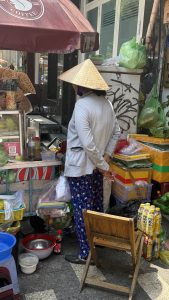
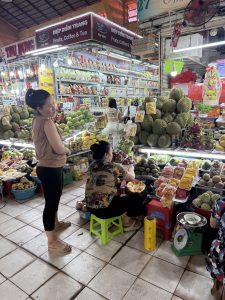
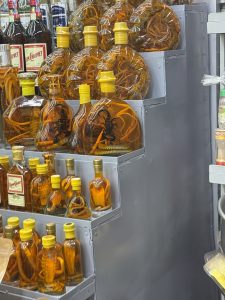
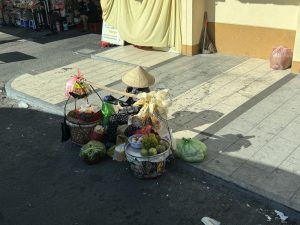
For our final stop we were taken to Cho’ Ben Thanh Market, also known as Saigon Market. We had officially reached the heart of the city. The sprawling French inspired architecture of the building is imposing, standing in the center of several bustling streets. Over more than a century, the Ben Thanh Market has not only been a bustling trading place but also a historical witness associated with the ups and downs of Saigon. There are nearly 1,500 booths to explore and more than 6,000 small businesses are represented. The massive market is divided into four sections with souvenir shops and handicrafts grouped together. There is another section for fresh foods, seafood and street food stalls, while clothing and accessories are in another section. Dried goods and local specialties make up the final grouping of stalls. With over 10,000 people visiting each day, it was interesting but also completely overwhelming with the vendors hustling for business and wall to wall people. Except for the snakes and insects in bottles, most stalls were selling the same things. We lasted about 15 minutes before making our way back outside. We returned to the bus to wait for the remainder of the tour group to finish shopping. I had more fun watching a woman from the window of the bus. She had been dropped off on the back of a motorbike and unpacked a variety of stacked baskets, to create a full service farmers market right on the sidewalk. I imagined most of the produce had been grown at her home. I wondered what her story was. What would she share about her country? Perhaps she had already given me a glimpse through that window.
I spent the hour and a half of the return journey, reflecting on the timeline of history which we had covered. It had indeed been a cattle prod tour, the kind we generally try to avoid, but reminiscing upon our day we realized that we had, had a wonderful overview of history and immersion in culture. Overall, we were happy we had picked this “Best of” tour at the beginning of our Vietnam journey.
After over a year of planning, we are off! Today we set the course for our next adventure. We are embarking on a 25 day cruise, with 10 additional days of land travel. We will have 5 days in Singapore before the cruise and 5 days after, in Tokyo. In between we will visit Thailand, Vietnam, China, Taiwan, South Korea, and Japan.
When Alan retired, we made a commitment to see all 7 of the continents before he turned 70 . Asia was the fourth continent on our bucket list. We still have South America and Antarctica to do. Technically Alan had fulfilled the Asia goal the year before he met me. In 1980, he took a 6 week training course in Japan. I too have fulfilled my Asia continent goal, while traveling on a portion of the World Cruise in 2023.
On that trip we met so many widows who hadn’t made it to their 50th Anniversary, with their spouses. We also met many people who had become infirmed by illness or injury before they turned 70. We decided to do our long distance traveling with as much speed as financial resources and health would allow.
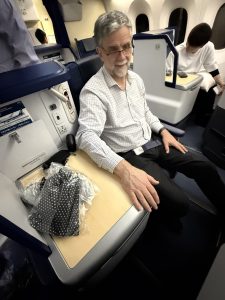
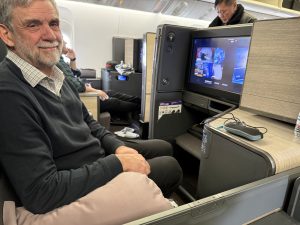
Just six weeks ago we returned home from a trip to England. The known stressors that we would be facing on that journey, had made us move up to business class. If you know anything about us, it is that we are very frugal. Business class is not a luxury we have never indulged in, until recently. As soon as we completed that flight to England, we instantly began to search if we could upgrade for the Asia trip (our longest flight yet). Alan realized we had some unused mileage points and combined with a good flight sale, it made the tickets attainable. These two bodies are not as young as they once were and this extra space and the ability to lay down means that we will hopefully arrive to our destination refreshed and ready to start our vacation.
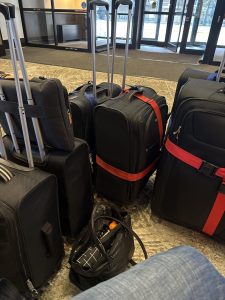
When going on a long cruise, we don’t travel light, we pack for comfort and convenience, which means we likely bring too many things. On this trip, we have 4 suitcases (2 large and 2 medium) and our carry-ons. For clothing, I have my list pretty well established and I could probably get by with a single suitcase. It is the room organization, which takes up so much space in our luggage (as I said, comfort and convenience). You probably wouldn’t believe me if I told you I am carrying laundry pods, paper plates, snacks and a full service first aid and medical kit, but I am! I will share more about our packing lists on another post. Normally we buy these things at our starting port when flying, but they will be a little more difficult to source in Singapore, so we have them in the luggage.
The other benefits to flying business class, are that we are able to take 70lbs per suitcase. I don’t recommend this, as ultimately it will be us who is lugging the cases around. For the benefit of others, we still try to stick to the 50 lb rule. My cases for this trip have all come in around 40-45 pounds and we will be shedding many consumable items as we travel.
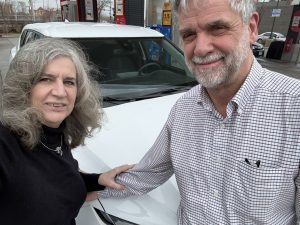
We had been so incredibly prepared for this trip. I began packing about six weeks ago, just after we returned from England. Weeding out the things we didn’t need and adding in a few new things we did, such as a snorkel and mask. What I hadn’t counted on was a freak snowstorm to disrupt our plans. When we saw the storm was expected to dump 2-3 feet of snow, Alan changed our flight plan to leave a day early (Sunday). The airline cancelled those plans on Saturday morning and re-booked us on the original Monday flight from Traverse City to Chicago. By then it looked like travel would be impossible, the airline just hadn’t realized it yet. With about 15 minutes notice, Alan decided to hire a rental car in Traverse City and gave me 2 hours to be ready to go. It was the last car available! This was Saturday night, just hours before the storm was due to begin but still nearly forty hours before our connecting flight in Chicago. I’m pleased to say that I had the car loaded in record time! My organization had really paid off. We closed down the house and set off for our six hour commute to Chicago.
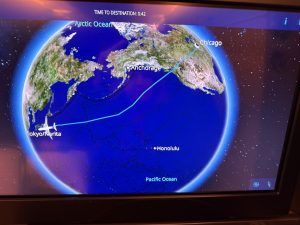
In the interest of time, I will detail our journey to Chicago in a different post but needless to say we made our flight bound for Tokyo, roughly on time (Monday morning). We were delayed an hour as they de-iced the plane, twice. It is a 13 hour flight with a 3 hour layover, then we will travel another 7 hours on to Singapore.
We are not getting any younger, so at the last minute, we upgraded to business class, hoping this would help us rest and arrive with a little less jet lag. We each got about 4 hours of sleep.
The meal on the flight was a choice of Asian or Western cuisine which on All Nippon Air means we still only had a choice of a variety of fish based items. Knowing how fussy we are for “basic” foods, we had stocked up on Subway Sandwiches! Our hope was that we could eat these for our dinner. I think it will be terribly amusing when we pull these out, in Business Class. It gave my mother a chuckle to hear we have a cooler with us. This too is part of our cruise supplies. We love creating impromptu picnics in port (or on a plane).
At 4:30pm local time, we landed at Haneda airport in Tokyo, Japan. We were now officially in ASIA!
We will have just a two hour layover, since we are a little late. Once again we will be taking advantage of the International Lounge. While sitting in the lounge, we spent some time dreaming about the countries we would see on this trip…Singapore, Thailand, Vietnam, China, Taiwan, South Korea and Japan.
We keep pinching ourselves that we are actually here and beginning this Asia adventure.
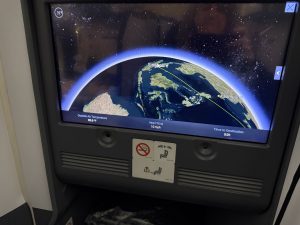
By the time we set off for Singapore, our old butts were really beginning to drag. While only 6:30 pm local time, it was now 4:30 am our time. We still had a 7 1/2 hour flight to our final destination. Our only goal on this last leg was to sleep.
We arrived in Singapore at 1am local time. With the 12 hour time difference we were now pushing our 27 hour window. With the stress of the additional travel days, we were ready for our hotel.
When we travel, we take each section in bite size chunks. We still had Customs and Immigration to clear and our past experience with Singapore had not been pleasant, they are notorious for long lines. Three days before we set off, we were required to complete our visa online. With the significant time change this meant we did it in the hotel before setting off for the flight. The new digital entry has now made the whole process relatively stress free and fast.
After picking up our bags (which thankfully had all made it), we were met by our pre-arranged taxi driver and whisked away to our hotel. In 20 minutes we were there. In 45 minutes we were checked into our room and in bed. The time is now nearing 3 a.m., which was 3 p.m. at home. We have a full day of adventures planned “today”, so we need to get a few more hours of sleep before we set off. Goodnight or good morning, depending on where you are in the world! Welcome to our Asian Adventure!